Chronological List of the
Old Testament Prophets
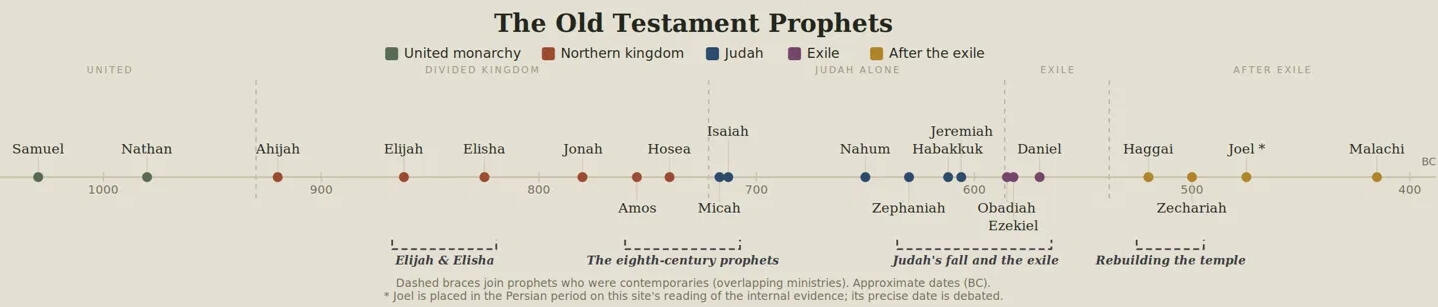
This is a list of all the Old Testament prophets as they were called by The God of the Hebrews, YHWH, their timelines and what they were known for. The exploits listed here are not exhaustive.
Click HERE to send the author a message...

Samuel (1050-1010 BC)
Context:
The son of Hannah, a second wife of Elkanah, an Ephramaite from Ramathaim Zophim. Hannah had made a vow to God to dedicate her son to Him, if He did, indeed give her a child. Samuel was the last judge of Israel during the transition from tribal confederacy to monarchy, and operated amid Philistine threats and internal disunity.When the people rejected leadership by God in favour of a monarchy, Samuel warned them what a king would do to them; that the king would enslave them and their children and take what they held dear for his own, but they did not heed his warning.He anointed Saul as Israel's first king and later David, emphasizing God's sovereignty over human leaders and his era marked the shift from theocracy to monarchy, with themes of obedience and rejection of foreign idols.He is also attributed with the chronicling of King David's reign and works.The author or authors of 1 and 2 Samuel are not known. These books recount the stories of Samuel, Saul, and David and the prophet Nathan, as well. Saul's reign began between 1050-1030 BC and ended in 1010 BC. David then reigned until 971 BC. The books were probably written soon after the end of his reign.
Relevant Biblical Verses:
Samuel's Dedication
1 Samuel 1:5-7,11 - 5But to Hannah, Elkanah would give a double portion, for he loved Hannah, although the Lord had closed her womb. 6And her rival also provoked her severely, to make her miserable, because the Lord had closed her womb. 7So it was, year by year,...that she provoked her; therefore she wept and did not eat... 11Then she made a vow and said, “O Lord of hosts, if You will indeed look on the affliction of Your maidservant and remember me, and not forget Your maidservant, but will give Your maidservant a male child, then I will give him to the Lord all the days of his life, and no razor shall come upon his head.”Samuel's Calling
1 Samuel 2:1,10 - 1Now the boy Samuel ministered to the Lord before Eli. And the word of the Lord was rare in those days; there was no widespread revelation... 10Now the Lord came and stood and called as at other times, “Samuel! Samuel!”
And Samuel answered, “Speak, for Your servant hears.”Samuel Judges Israel
1 Samuel 7:3-4,13-15 - 3Then Samuel spoke to all the house of Israel, saying, “If you return to the Lord with all your hearts, then put away the foreign gods and the Ashtoreths from among you, and prepare your hearts for the Lord, and serve Him only; and He will deliver you from the hand of the Philistines.” 4So the children of Israel put away the Baals and the Ashtoreths, and served the Lord only... 13So the Philistines were subdued,... And the hand of the Lord was against the Philistines all the days of Samuel. 14Then the cities which the Philistines had taken from Israel were restored to Israel...and Israel recovered its territory from the hands of the Philistines... 15And Samuel judged Israel all the days of his life.Israel Demands a King
1 Samuel 8:6 - 6But the thing displeased Samuel when they said, “Give us a king to judge us.” So Samuel prayed to the Lord. 7And the Lord said to Samuel, “Heed the voice of the people in all that they say to you; for they have not rejected you, but they have rejected Me, that I should not reign over them.”Saul Chosen to Be King
1 Samuel 9:15-16 - 15Now the Lord had told Samuel in his ear the day before Saul came, saying, 16“Tomorrow about this time I will send you a man from the land of Benjamin, and you shall anoint him commander over My people Israel, that he may save My people from the hand of the Philistines.”Saul Annointed and Proclaimed King
1 Samuel 10:1,23-24 - 1Then Samuel took a flask of oil and poured it on his head, and kissed him and said: “Is it not because the Lord has anointed you commander over His inheritance?”... 23So they ran and brought him from there; and when he stood among the people, he was taller than any of the people from his shoulders upward. 24And Samuel said to all the people, “Do you see him whom the Lord has chosen, that there is no one like him among all the people?” So all the people shouted and said, “Long live the king!”Chronicling the works of King David
1 Chronicles 29:29 - Now the acts of King David, first and last, indeed they are written in the book of Samuel the seer...

Nathan (1010-950 BC)
Context:
Serving as court prophet and as a trusted advisor, divine messenger, and counsellor to King David in the united kingdom of Israel's golden age, Nathan also confronted David's adultery with Bathsheba.His close relationship with David allowed him to boldly convey God's messages, sometimes affirming the king's plans, other times confronting sin, and he played a pivotal role in ensuring the succession of Solomon to the throne.His ministry emphasized accountability, covenant promises, and faithfulness, making him a model of prophetic integrity in the Hebrew Bible. He prophesied the establishment of David's eternal throne. His ministry highlighted royal accountability to God, set against David's military expansions and temple planning.Nathan is also attributed to chronicling the reign and works of King David and his son, Solomon.
Hezekiah referenced Nathan's commandments in establishing Levitical worship practices (2 Chronicles 29:25).
Relevant Biblical Verses:
David's Desire to Build a Temple for God leads to The Davidic Covenant
2 Samuel 7:2-5, 12-16 - "2...the king said to Nathan the prophet, “See now, I dwell in a house of cedar, but the ark of God dwells inside tent curtains.” 3Then Nathan said to the king, “Go, do all that is in your heart, for the Lord is with you.” 4But it happened that night that the word of the Lord came to Nathan, saying, 5“Go and tell My servant David, “Thus says the Lord: 'Would you build a house for Me to dwell in?'”' ... 12“When your days are fulfilled and you rest with your fathers, I will set up your seed after you, who will come from your body, and I will establish his kingdom. 13He shall build a house for My name, and I will establish the throne of his kingdom forever. 14I will be his Father, and he shall be My son. If he commits iniquity, I will chasten him with the rod of men and with the blows of the sons of men. 15But My mercy shall not depart from him,... 16And your house and your kingdom shall be established forever before you. Your throne shall be established forever.” ’ ”David Sin with Bathsheba, Nathan's Parable and David's Confession
2 Samuel 12-1-14 - 1Then the Lord sent Nathan to David. And he came to him, and said to him: “There were two men in one city, one rich and the other poor. 2The rich man had exceedingly many flocks and herds. 3But the poor man had nothing, except one little ewe lamb...; and it grew up together with him and with his children...and it was like a daughter to him. 4And a traveler came to the rich man, ...took the poor man’s lamb and prepared it for the man who had come to him.”
5So David’s anger was greatly aroused against the man, and he said to Nathan, “As the Lord lives, the man who has done this shall surely die!”...
7Then Nathan said to David, “You are the man! Thus says the Lord God of Israel: ‘I anointed you king over Israel, and I delivered you from the hand of Saul. 8I gave you your master’s house and your master’s wives into your keeping, and gave you the house of Israel and Judah. And if that had been too little, I also would have given you much more!”...13So David said to Nathan, “I have sinned against the Lord.”Adonijah Presumes to Be King; Nathan protects the throne for Solomon
1 Kings 1:5,8,11-14 - 5Then Adonijah the son of Haggith exalted himself, saying, “I will be king”; ... 8But Zadok the priest, Benaiah the son of Jehoiada, Nathan the prophet, Shimei, Rei, and the mighty men who belonged to David were not with Adonijah... 11So Nathan spoke to Bathsheba the mother of Solomon, saying, “Have you not heard that Adonijah the son of Haggith has become king, and David our lord does not know it? 12Come, please, let me now give you advice, that you may save your own life and the life of your son Solomon. 13Go immediately to King David and say to him, ‘Did you not, my lord, O king, swear to your maidservant, saying, “Assuredly your son Solomon shall reign after me, and he shall sit on my throne”? Why then has Adonijah become king?’ 14Then, while you are still talking there with the king, I also will come in after you and confirm your words.”Chronicling the works of King David and Solomon
1 Chronicles 29:29 - 29Now the acts of King David, first and last, indeed they are written in the book of Samuel the seer, in the book of Nathan the prophet...Reference to Nathan's commandments by the Lord for the Levites' worship
2 Chronicles 29:25 - 25And he stationed the Levites in the house of the Lord with cymbals, with stringed instruments, and with harps, according to the commandment of David, of Gad the king’s seer, and of Nathan the prophet; for thus was the commandment of the Lord by His prophets.

Ahijah (930-910 BC)
Context:
Ahijah the Shilonite was a Levite prophet from Shiloh, active during the late reign of King Solomon and the early divided monarchy (approximately 930–910 BC).He is primarily known for his role in foretelling the division of the united kingdom of Israel into the northern kingdom (Israel) and the southern kingdom (Judah), as well as delivering judgments against the house of Jeroboam I, the first king of the north.As a prophet from Shiloh, a city central to early Israelite worship and home to the tabernacle, Ahijah represented God's sovereignty amid political upheaval, idolatry, and covenant unfaithfulness.His ministry emphasized divine judgment on Solomon's apostasy and the consequences of rejecting God's ways, while offering conditional promises of blessing for obedience.
Relevant Biblical Verses:
Prophecy of the Kingdom's Division to Jeroboam
1 Kings 11:29-33 - 29Now it happened at that time, when Jeroboam went out of Jerusalem, that the prophet Ahijah the Shilonite met him on the way; and he had clothed himself with a new garment, and the two were alone in the field. 30Then Ahijah took hold of the new garment that was on him, and tore it into twelve pieces. 31And he said to Jeroboam, “Take for yourself ten pieces, for thus says the Lord, the God of Israel: ‘Behold, I will tear the kingdom out of the hand of Solomon and will give ten tribes to you 32(but he shall have one tribe for the sake of My servant David, and for the sake of Jerusalem, the city which I have chosen out of all the tribes of Israel), 33because they have forsaken Me, and worshiped Ashtoreth the goddess of the Sidonians, Chemosh the god of the Moabites, and Milcom the god of the people of Ammon...’ ”
This event fulfilled God's earlier word against Solomon's idolatry (1 Kings 11:1-13).Prophecy of Kingdom's division and Samuel's prophecy against monarchy fulfilled
1 Kings 12:13-15 - 13Then the king answered the people roughly, and rejected the advice which the elders had given him; 14and he spoke to them according to the advice of the young men, saying, “My father made your yoke heavy, but I will add to your yoke; my father chastised you with whips, but I will chastise you with scourges!” 15So the king did not listen to the people; for the turn of events was from the Lord, that He might fulfill His word, which the Lord had spoken by Ahijah the Shilonite to Jeroboam the son of Nebat.Prophecy of Judgment on Jeroboam's House
1 Kings 14:2,5-12,17 - 2And Jeroboam said to his wife, “Please arise, and disguise yourself, that they may not recognize you as the wife of Jeroboam, and go to Shiloh. Indeed, Ahijah the prophet is there, who told me that I would be king over this people.” 5Now the Lord had said to Ahijah, “Here is the wife of Jeroboam, coming to ask you something about her son, for he is sick. Thus and thus you shall say to her; for it will be, when she comes in, that she will pretend to be another woman.”
6And so it was, when Ahijah heard the sound of her footsteps as she came through the door, he said, “Come in, wife of Jeroboam. Why do you pretend to be another person? For I have been sent to you with bad news.
7Go, tell Jeroboam, ‘Thus says the Lord God of Israel: “Because I exalted you from among the people, and made you ruler over My people Israel, 8and tore the kingdom away from the house of David, and gave it to you; ... 9but you have done more evil than all who were before you, ... 10therefore behold! I will bring disaster on the house of Jeroboam, and will cut off from Jeroboam every male in Israel, bond and free... 11The dogs shall eat whoever belongs to Jeroboam and dies in the city, and the birds of the air shall eat whoever dies in the field; for the Lord has spoken!” ’ 12Arise therefore, go to your own house. When your feet enter the city, the child shall die.” 17Then Jeroboam’s wife arose and departed, and came to Tirzah. When she came to the threshold of the house, the child died.

Elijah the Tishbite (875–850 BC)
Context:
Elijah (meaning "My God is Yahweh") was a fiery 9th-century BC prophet in the northern kingdom of Israel during the reign of King Ahab of Samaria, the northern kingdom of Israel and his Sidonian Queen Jezebel (c. 874–853 BC) and Ahab's son, Ahaziah.Emerging suddenly in the Biblical narrative as "Elijah the Tishbite" from Gilead, he served as God's bold confrontational voice against rampant idolatry, particularly the worship of Baal and Asherah that had been made the state religion by Queen Jezebel (her name, best understood as meaning "Where is the Lord?" -a ritual cry in pagan worship ceremonies-, is synonymous with idolatry and Baal worship).His ministry, spanning about 25 years, was marked by dramatic miracles, divine encounters, and personal struggles with doubt and isolation, making him a symbol of unwavering zeal for Yahweh amid apostasy. His context was religious syncretism, with themes of God's exclusive power and zeal for pure worship, making him the very type of unwavering zeal for the Lord amid apostasy.Elijah marked the beginning of the end of Baal worship in Israel, challenging the syncretism (The fusion of differing systems of belief) that threatened Yahweh's exclusive claim and restoring monotheistic fervor through public demonstrations of God's power. His great work was to force Israel's choice between Yahweh and Baal, most famously in the contest on Mount Carmel. Yet his story is not all triumph: fresh from Carmel he collapses into despair and flees, and God meets him not in wind, earthquake, or fire but in "a still small voice" (1 Kings 19:12), teaching that the Lord works as often in the whisper as in the flame.As the archetypal prophet, Elijah embodies both restoration and confrontation with evil. He appears with Moses at the Transfiguration of Jesus (Matthew 17:3), the two of them representing the Law and the Prophets.Malachi 4:5 prophesies Elijah's return, “Behold, I will send you Elijah the prophet before the coming of the great and dreadful day of the Lord.", positioning him as a harbinger of the Messiah and eschatological judgment.Elijah is only one of three people to never have died and went up bodily into Heaven (2 Kings 2:11; ...suddenly a chariot of fire appeared with horses of fire...and Elijah went up by a whirlwind into heaven.). The other two being Enoch (Genesis 5:24; And Enoch walked with God; and he was not, for God took him.) and Jesus (Acts 1:9; ...while they watched, He was taken up, and a cloud received Him out of their sight.)
Relevant Biblical Verses:
Announcement of Drought and Miraculous Provision
1 Kings 17:1 - 1And Elijah the Tishbite, of the inhabitants of Gilead, said to Ahab, “As the Lord God of Israel lives, before whom I stand, there shall not be dew nor rain these years, except at my word.”Elijah and the Widow and the never-ending bin of flour and jar of oil
1 Kings 17:13-16; 13And Elijah said to her, “...make me a small cake from it first, and...make some for yourself and your son. 14For thus says the Lord God of Israel: ‘The bin of flour shall not be used up, nor shall the jar of oil run dry, until the day the Lord sends rain on the earth.’ ”
15So she went away and did according to the word of Elijah; and she and he and her household ate for many days. 16The bin of flour was not used up, nor did the jar of oil run dry, according to the word of the Lord which He spoke by Elijah.Elijah Revives the Widow’s Son
1 Kings 17:17-22; 17Now it happened...that the son of the woman who owned the house became sick. And his sickness was so serious that there was no breath left in him. 18So she said to Elijah, “What have I to do with you, O man of God? Have you come to me to bring my sin to remembrance, and to kill my son?”
19And he said to her, “Give me your son.”... 20Then he cried out to the Lord and said, “O Lord my God, have You also brought tragedy on the widow with whom I lodge, by killing her son?” 21... “O Lord my God, I pray, let this child’s soul come back to him.” 22Then the Lord heard the voice of Elijah; and the soul of the child came back to him, and he revived.Confrontation on Mount Carmel
1 Kings 18:22-24,26-28,30,33-36,38; 22Then Elijah said to the people, “I alone am left a prophet of the Lord; but Baal’s prophets are four hundred and fifty men. 23Therefore let them give us two bulls; and let them choose one bull...and I will prepare the other bull... 24Then you call on the name of your gods, and I will call on the name of the Lord; and the God who answers by fire, He is God.” ...
26So they took the bull...and they prepared it, and called on the name of Baal from morning even till noon... 27Elijah mocked them and said, “Cry aloud, for he is a god; either he is meditating... busy... on a journey, or...sleeping and must be awakened.” 28So they cried aloud, and cut themselves, as was their custom, with knives and lances, until the blood gushed out on them...
30Then Elijah...repaired the altar...33And he put the wood in order, cut the bull in pieces, and laid it on the wood, and said, “Fill four waterpots with water, and pour it on the burnt sacrifice and on the wood.” 34Then he said, “Do it a second time,” and they did it a second time; and he said, “Do it a third time,” and they did it a third time. 35So the water ran all around the altar; and he also filled the trench with water. 36...Elijah the prophet came near and said, “Lord God of Abraham, Isaac, and Israel, let it be known this day that You are God in Israel and I am Your servant, and that I have done all these things at Your word...” 38Then the fire of the Lord fell and consumed the burnt sacrifice, and the wood and the stones and the dust, and it licked up the water that was in the trench.(abridged)End of the Drought
1 Kings 18:41,45; 41Then Elijah said to Ahab, “Go up, eat and drink; for there is the sound of abundance of rain.” 45Now it happened...that the sky became black with clouds and wind, and there was a heavy rain.Despair, and the Angel's Food
1 Kings 19:4-8 - Fleeing Jezebel, Elijah collapses in the wilderness and prays to die: 4And he prayed that he might die, and said, “It is enough! Now, Lord, take my life, for I am no better than my fathers!” Instead an angel feeds him twice, 5...as he lay and slept under a broom tree, suddenly an angel touched him, and said to him, “Arise and eat.” 6...and there by his head was a cake baked on coals, and a jar of water. So he ate and drank, and lay down again. 7And the angel of the Lord came back the second time, and touched him, and said, “Arise and eat, because the journey is too great for you.” 8So he arose, and ate and drank; and he went in the strength of that food forty days and forty nights as far as Horeb, the mountain of God.The Still Small Voice
1 Kings 19:11-18; 11...a great and strong wind... but the Lord was not in the wind; ...an earthquake, but the Lord was not in the earthquake; 12...a fire, but the Lord was not in the fire; and after the fire a still small voice. God recommissions the weary prophet and assures him he is not alone: 18"Yet I have reserved seven thousand in Israel, all whose knees have not bowed to Baal..." the faithful remnant Paul later cites (ff: Romans 11:2-4).Naboth's Vineyard
1 Kings 21:17-19 - After Jezebel has Naboth murdered for his vineyard, Elijah confronts Ahab: 19"Have you murdered and also taken possession?... In the place where dogs licked the blood of Naboth, dogs shall lick your blood, even yours."Elijah Ascends to Heaven; Chariot of Fire
2 Kings 2:1,9-11; 1And it came to pass, when the Lord was about to take up Elijah into heaven by a whirlwind, that Elijah went with Elisha from Gilgal... 9And so it was, when they had crossed over, that Elijah said to Elisha, _“Ask! What may I do for you, before I am taken away from you?” Elisha said, “Please let a double portion of your spirit be upon me.” 10So he said, “You have asked a hard thing. Nevertheless, if you see me when I am taken from you, it shall be so for you...” 11Then it happened, as they continued on and talked, that suddenly a chariot of fire appeared with horses of fire, and separated the two of them; and Elijah went up by a whirlwind into heaven.

Elisha the son of Shaphat (850-800 BC)
Context:
Elisha's name means "God is Salvation". As Elijah's successor in the northern kingdom, active around 850-800 BC, Elisha advised kings like Jehoram, Jehu, and Joash during revolts against Baal and performed numerous miracles (e.g., raising the Shunammmite woman's son from the dead and healing Naaman, 2 Kings 4-5).Amid ongoing Aramean wars and political instability, his ministry focused on God's provision and judgment through prophetic signs.A farmer from Abel-meholah called while plowing (1 Kings 19:19-21), Elisha requested and received a "double portion" of Elijah's spirit, leading to a ministry renowned for abundant miracles, maybe twice as many as Elijah's, focusing on divine provision, healing, and judgment.Where Elijah's ministry was one of solitary confrontation, Elisha's was woven into the life of the nation: he counselled kings such as Jehoram, Jehu, and Joash through the long Aramean wars, and worked a great many miracles, by tradition twice as many as his master, most of them quiet acts of provision, healing, and rescue for the ordinary and the vulnerable.His miracles run remarkably parallel to those of Christ: he multiplies oil for a widow, raises a dead boy, cleanses a leper, purifies poisoned food, and feeds a hundred men from twenty loaves with food left over (2 Kings 4:42-44), prefiguring the feeding of the multitudes. Even the cleansing of Naaman the Syrian becomes, in Jesus' mouth, a rebuke to unbelieving Israel and a sign that God's mercy reaches the Gentiles (ff: Luke 4:27).Elisha's ministry was the longest of any prophet, spanning some fifty years and six kings, and unlike the solitary Elijah he led the sons of the prophets, the prophetic guilds at Gilgal, Bethel, and Jericho. He moved freely between the cottage and the throne room, and his hand can be seen behind the great political upheaval of the age: it was Elisha who set in motion the Jehu revolution that finally destroyed the house of Ahab.
Relevant Biblical Verses:
Calling as Elijah's Successor and First Miracles
2 Kings 2:1-24 - Elisha insists on following Elijah to the Jordan, requesting a double portion of his spirit. Witnessing Elijah's ascension in a fiery chariot, Elisha takes the fallen mantle, parts the Jordan river, heals Jericho's bad water with salt, and curses mocking youths who are mauled by bears, affirming his prophetic authority.Water for the Three Kings
2 Kings 3:9-20 - When Jehoram, Jehoshaphat, and the king of Edom are stranded without water on the campaign against Moab, Elisha (for Jehoshaphat's sake) prophesies deliverance: 17"You shall not see wind, nor shall you see rain; yet that valley shall be filled with water." By morning the land is flooded and Moab is routed.Miracle of the Widow's Oil
2 Kings 4:1-7 - A prophet's widow faces debt and enslavement of her sons; Elisha instructs her to borrow vessels and pour her small jar of oil, which multiplies until all are full, allowing her to sell it and live debt-free, highlighting God's provision for the vulnerable.Raising the Shunammite Woman's Son
2 Kings 4:8-37 - A wealthy Shunammite woman provides Elisha hospitality and in gratitude, he prophesies she will bear a son. This comes to pass and the son grows up but dies suddenly as a youth. Elisha stretches over the boy, prays, and revives him thus demonstrating God's power over death."Death in the Pot"
2 Kings 4:38-41 - During a famine, poisonous gourds are stewed for the sons of the prophets, who cry out, 40"O man of God, there is death in the pot!" Elisha throws in flour and the food is made harmless, one of his many quiet mercies to the hungry.Healing of Naaman the Syrian
2 Kings 5:1-27; "1Now Naaman, commander of the army of the king of Syria, was a great and honorable man in the eyes of his master, because by him the Lord had given victory to Syria. He was also a mighty man of valor, but a leper."
Elisha instructs him to wash seven times in the Jordan, restoring his skin. Naaman's pride is initially hurt, but he listens to the counsel of those with him and obeys Elisha's command and his skin is restored. He immediately converts, but the greedy servant Gehazi is cursed with leprosy for taking bribes.The Floating Axe Head and Blinding the Arameans
2 Kings 6:1-23
Elisha makes a lost borrowed axe head float; later, he reveals the Aramean plans to Israel's king and blinds an invading army, leading them to Samaria for a feast instead of slaughter thereby promoting peace.The Siege of Samaria and the Four Lepers
2 Kings 6:24-7:20 - Elisha's greatest public sign. As the Arameans besiege Samaria, the famine grows so terrible that mothers boil their own children, yet Elisha promises that within a day food will be cheap at the gate. A scoffing royal officer sneers, 2 Kings 7:2; "...could this thing be?" and Elisha replies that he will see it but not eat of it. That night God makes the Arameans hear "the noise...of a great army," and they flee; four lepers stumble upon the abandoned camp, and the city is saved, while the officer is trampled to death in the gateway, exactly as foretold.Prophecy to Hazael
2 Kings 8:7-15 - In Damascus, Elisha weeps while foretelling Syrian king Ben-Hadad's death and Hazael's brutal reign over Israel; Hazael, his servant, murders the king and usurps the throne. Years earlier God had told Elijah, “You are to anoint Hazael king over Aram.” (1 Kings 19:15) The mantle of that assignment passes to Elisha, who prophetically recognizes Hazael’s future kingship and the havoc he will wreak (2 Kings 8:10–12). The scene in 8:14 is the hinge where that prophecy begins to unfold.The Anointing of Jehu
***2 Kings 9:1-13 - Elisha sends one of the sons of the prophets to anoint Jehu king over Israel, 7"You shall strike down the house of Ahab your master" unleashing the purge that ends Jezebel's line and fulfils Elijah's word over Naboth's vineyard.Elisha's Death and Posthumous Miracle
2 Kings 13:14-21 - On his deathbed, Elisha prophesies victory to King Joash via arrows; after burial, a dead man's body touching Elisha's bones revives him marking this Elisha's posthumous, final miracle.

Jonah son of Amittai (780 BC)
Context:
The son of Amittai and hailing from Gath-hepher in the northern kingdom of Israel, Jonah was active during the prosperous but idolatrous reign of King Jeroboam II (c. 793–753 BC) and he was no mere literary figure either. 2 Kings records that Jeroboam restored Israel's borders "which He had spoken through His servant Jonah the son of Amittai" (2 Kings 14:25), placing him as a real court prophet of the eighth century.Sent to the Assyrian capital Nineveh during a brief period of Assyrian mercy toward Israel, Jonah's reluctant mission highlighted God's compassion for Gentiles.Unlike most prophetic books, Jonah is a narrative rather than a collection of oracles, and its subject is his reluctant mission to Nineveh, the Assyrian capital, a hated enemy city that stood for Gentile wickedness. Called to preach against it, Jonah instead flees toward Tarshish, is caught in a God-sent storm, and asks the crew to throw him overboard, whereupon he is swallowed by a great fish and, from its belly, prays and is delivered onto dry land. Obeying the second time, he preaches, and to his dismay the whole city repents and is spared.The book's true climax is its fourth chapter. Furious that God has shown mercy to Israel's enemy, Jonah sulks outside the city, causing God to appoint a leafy plant to shade him, and then sending a worm to kill it. God uses Jonah's anger over the withered plant to press the closing question of the whole book: if Jonah pities a plant he did not make, should God not pity Nineveh with its 120,000 souls? The book ends on that unanswered question, holding a mirror to every reader who would rather see judgment than mercy. Irony runs throughout, as the pagan sailors and the pagan city both prove more responsive to God than His own prophet and thus, the book uses satire and irony to explore Jonah's flawed character, making it a unique theological parable.Above all, Jonah became, in Jesus' own teaching, a sign pointing to Himself. Challenged for a sign, Jesus answered that none would be given except "the sign of the prophet Jonah" (Matthew 12:39): as Jonah spent three days and three nights in the fish, so the Son of Man would lie three days and nights in the heart of the earth before rising, making Jonah's ordeal and deliverance a type of the death and resurrection of Christ. In the same breath He warned that the men of Nineveh, who repented at Jonah's preaching, would rise in judgment against His own generation, for "a greater than Jonah is here" (Matthew 12:41).
Relevant Biblical Verses:
Jonah’s Disobedience
Jonah 1:1-3; 1Now the word of the Lord came to Jonah the son of Amittai, saying, 2“Arise, go to Nineveh, that great city, and cry out against it; for their wickedness has come up before Me.”_ 3But Jonah arose to flee to Tarshish from the presence of the Lord. He went down to Joppa, and found a ship going to Tarshish; so he paid the fare...4But the Lord sent out a great wind on the sea,...so that the ship was about to be broken up."_Jonah Thrown into the Sea and is swallowed by a great fish
Jonah 1:12,17; 12And he said to them, “Pick me up and throw me into the sea;... For I know that this great tempest is because of me.” 17Now the Lord had prepared a great fish to swallow Jonah. And Jonah was in the belly of the fish three days and three nights."Jonah’s Prayer and God’s Answer
Jonah 2:1-2,10; 1Then Jonah prayed to the Lord his God from the fish’s belly. 2And he said: “I cried out to the Lord because of my affliction, And He answered me. Out of the belly of Sheol I cried, And You heard my voice.” ... 10So the Lord spoke to the fish, and it vomited Jonah onto dry land."Jonah Preaches at Nineveh and The People of Nineveh Believe
Jonah 3:1-3,5,10; 1Now the word of the Lord came to Jonah the second time, saying, 2“Arise, go to Nineveh, that great city, and preach to it the message that I tell you.” 3So Jonah arose and went to Nineveh, according to the word of the Lord. 5So the people of Nineveh believed God, proclaimed a fast, and put on sackcloth...10Then God saw their works, that they turned from their evil way; and God relented from the disaster that He had said He would bring upon them, and He did not do it.God's Compassion and the Withered Plant
Jonah 4:1-11; 1But it displeased Jonah exceedingly, and he became angry. 2So he prayed to the Lord and said, "...I know that You are a gracious and merciful God, slow to anger and abundant in lovingkindness, One who relents from doing harm." God then appoints a plant to shade him, a worm to wither it, and a scorching east wind, and closes the book with a question: 10"You have had pity on the plant for which you have not laboured, nor made it grow, which came up in a night and perished in a night. 11And should I not pity Nineveh, that great city, in which are more than one hundred and twenty thousand persons who cannot discern between their right hand and their left...?"The Sign of Jonah
Matthew 12:39-41; 39"An evil and adulterous generation seeks after a sign, and no sign will be given to it except the sign of the prophet Jonah. 40For as Jonah was three days and three nights in the belly of the great fish, so will the Son of Man be three days and three nights in the heart of the earth. 41The men of Nineveh will rise up in the judgment with this generation and condemn it, because they repented at the preaching of Jonah; and indeed a greater than Jonah is here." (cf. Matthew 16:4 and Luke 11:29-32)A note about the "three days and nights":
Some ask how "three days and three nights" (Matthew 12:40) fits a Friday-to-Sunday timeline. The answer lies in how the Hebrews reckoned a day. From the first chapter of the Bible a day is counted whole as "So the evening and the morning were the first day" (Genesis 1:5), a single night-and-day unit beginning at sunset, and in Hebrew idiom any part of such a unit counts as the whole. So "three days and three nights" means parts of three calendar days, not seventy-two literal hours. Scripture uses the phrase exactly this way elsewhere: in 1 Samuel 30:12-13 a man goes without food "three days and three nights", then says he fell sick "three days ago", treating the two as identical; and Esther fasts "three days, night or day" (Esther 4:16) yet approaches the king "on the third day" (Esther 5:1), not the fourth. So Christ, buried before sunset on the Friday, resting through the Sabbath, and raised at dawn on the Sunday, lay in the grave across parts of three "evening and morning" days, precisely the sign of Jonah, and precisely why He foretold rising "on the third day" (Matthew 16:21) rather than after three full days.
Joel son of Pethuel (Dates unknown)
Context:
Almost nothing is known about the prophet himself. He is introduced only as "Joel son of Pethuel" (Joel 1:1), and neither name anchors him to a known family or reign. The name Joel (Yo'el) means "Yahweh is God", a fitting banner for a book so concerned with turning the people back to him. His intense focus on Zion, the temple, the offerings, and the priesthood suggests he was a Judahite closely tied to Jerusalem, possibly a prophet who worked within the temple's worshipping life, though that is inference rather than record.The book is brief, and a wrinkle worth noting is that the versification differs. English Bibles have three chapters, while the Hebrew version has four. In the English version, Joel 2:28-32 is the Hebrew version Joel 3:1-5, and the English version of Joel chapter 3 is the Hebrew version, Joel chapter 4.The dating problemThe book contains no king, no datable event, and no named empire, so proposals range across more than four centuries, from the ninth to the fourth. The traditional early date (around 835–800, during the minority of Joash) leans on Joel's canonical position among the early prophets, the absence of a reigning king (fitting a boy-king under priestly regency), and the cast of enemies (Philistia, Phoenicia, Egypt, Edom) rather than Assyria or Babylon. The majority modern view, (including this author's, arguments for which are below) places it post-exilic, in the Persian period around 500-400. That case rests on the functioning temple and priest-led community with no monarchy, an apparent reference to the exile and the scattering of Israel as already past (Joel 3:2), the mention of Greeks buying Judean slaves (Joel 3:6), and the way Joel seems to echo and draw on other prophets such as Amos, Obadiah, and Zephaniah, which reads more naturally if he is later and citing them. The honest position is that the evidence is genuinely indeterminate; most scholars now lean late, but it remains one of the least settled dating questions in the Old Testament.Structure and ContentThe book falls cleanly into two movements. The first, Joel 1:1-Joel 2:17) is catastrophe and summons. A devastating locust plague, compounded by drought, has stripped the land, described in waves through four Hebrew locust terms in Joel 1:4 that may denote stages, species, or sheer rhetorical intensification.The disaster reaches even the temple, cutting off the grain and drink offerings, which turns an agricultural crisis into a crisis of worship. Joel reads it as a foretaste of the day of the Lord and calls the whole community, from elders to nursing infants to newlyweds, into fasting, lament, and a solemn assembly. (Author: Another argument for the post-exilic dating)In Joel 2:1-11 he describes The Day of The Lord; "A day of darkness and gloominess, A day of clouds and thick darkness..." The locusts escalate into a near-apocalyptic army heralding that day, "For the day of the Lord is great and very terrible; Who can endure it?" (Joel 2:11)The movement peaks at Joel 2:12-17 in the book's most quoted call, A Call To Repentance; “12Now, therefore,” says the Lord, “Turn to Me with all your heart, with fasting, with weeping, and with mourning.” and to "13rend your hearts and not your garments..." grounded in the ancient creed that; "For He is gracious and merciful, Slow to anger, and of great kindness; And He relents from doing harm."
It goes on to a call of action for the people to blow a trumpet and "15Consecrate a fast, call a sacred assembly; 16Gather the people, sanctify the congregation, assemble the elders,"The second movement (English translation, Joel 2:18 - 3:21, or in the Hebrew Bible, Joel 2:18 - 4:21) is God's answer and reversal. He pities the land, drives off the locust army, restores the harvest, and in the famous line of recompense, Joel 2:25; “So I will restore to you the years that the swarming locust has eaten, the crawling locust, the consuming locust, and the chewing locust,
My great army which I sent among you.Then comes the passages that made the book famous: Joel 2:28-29; “And it shall come to pass afterward that I will pour out My Spirit on all flesh; Your sons and your daughters shall prophesy,
Your old men shall dream dreams, Your young men shall see visions. 29And also on My menservants and on My maidservants I will pour out My Spirit in those days. “And I will show wonders in the heavens and in the earth: Blood and fire and pillars of smoke. 31The sun shall be turned into darkness, and the moon into blood, before the coming of the great and awesome day of the Lord.
32And it shall come to pass that whoever calls on the name of the Lord shall be saved.In the final chapter (Joel 3) God gather s the nations in the Valley of Jehoshaphat, a name meaning "Yahweh judges", and proclaims judgement on them for scattering Israel, dividing the land, and trafficking its people. It even inverts the famous swords-into-plowshares image; "Beat your plowshares into swords and your pruning hooks into spears; Let the weak say, ‘I am strong.’ ”" and closes on Zion secure, the nations judged, and the land renewed, with mountains dripping wine and a fountain flowing from the house of the Lord, the same image and motif seen in Ezekiel 47, Zechariah 14, John 7, and Revelation 22.
Key themesThe book is the Old Testament's central quarry for The Day of The Lord, holding together imminent judgment (the plague as its shadow) and final reckoning (cosmic signs, the nations judged, God's people saved). Around that turn its other concerns: genuine inward repentance and a God ready to relent; devastation answered by restoration; worship, priests, and assembly at the community's centre; and the striking democratization and mass outpouring of the Spirit across age, gender, and status.Joel's reach far exceeds its length, almost entirely through and because of one passage. At Pentecost, Peter stands and declares the Holy Spirit's outpouring to be the fulfilment of Joel, quoting Joel 2:28-32 directly as seen in Acts 2:16-21; 16But this is what was spoken by the prophet Joel: 17‘And it shall come to pass in the last days, says God, that I will pour out of My Spirit on all flesh;...abridged 21And it shall come to pass that whoever calls on the name of the Lord Shall be saved.’That single citation made Joel foundational for Christian understanding of the Holy Spirit and, later, the touchstone text of the whole Pentecostal and charismatic tradition. Embedded in the same quotation is "...everyone who calls on the name of the Lord shall be saved" (Acts 2:32), which Paul lifts in Romans 10:11-13 and applies to salvation in Christ for Jew and Gentile alike; 11For the Scripture says, “Whoever believes on Him will not be put to shame.” 12For there is no distinction between Jew and Greek, for the same Lord over all is rich to all who call upon Him. 13For “whoever calls on the name of the Lord shall be saved.”Beyond that, "...rend your hearts and not your garments..." (Joel 2:13) anchors the Ash Wednesday and Lent liturgies, "...the years the locust has eaten..." (Joel 2:25) has become a standard image of restoration, and Joel's darkened sun and blood-red moon feed the apocalyptic imagery picked up in the Gospels and Revelation.In this author's opinion: the case for a post-exilic JoelWhile the dating of Joel remains formally unsettled, the internal evidence points, in my view, decisively toward a post-exilic composition, most plausibly in the Persian period. Several lines of evidence converge.First, the community Joel addresses is one without a king. He summons elders, priests, and "...all the inhabitants of the land..." (Joel 1:2, 1:14, 2:1), and the leadership he invokes throughout is priestly rather than royal. The ministers of the altar, not a Davidic monarch, stand at the centre of the assembly (Joel 1:13, 2:17). This silence is telling. The pre-exilic prophets characteristically arraign the king; Joel has no throne to address, which fits a province governed under Persian administration with the temple as the community's surviving institution.Second, that temple is standing and functioning. The catastrophe's gravity is measured by the cutting off of the grain and drink offerings "...from the house of the LORD..." (Joel 1:9, 1:13, 2:14). The religious gathering being addressed is not a memory or a hope but a present reality whose interruption is the crisis. This points past the exile, when the temple lay in ruins, to the restored sanctuary of the post-exilic period.Third, the exile is treated as an accomplished fact. In the Day of The LORD oracle against the nations, God indicts them "On account of My people, My heritage Israel, whom they have scattered among the nations. They have also divided up My land." (Joel 3:2), and for selling Judeans into slavery (Joel 3:3-6). The dispersion is spoken of as past and complete, the ground of judgment rather than a threat still to come.Fourth, the horizon is unmistakably Persian-era. Joel condemns the sacking of the land and sale of Judean captives; "5Because you have taken My silver and My gold, and have carried into your temples My prized possessions. 6Also the people of Judah and the people of Jerusalem you have sold to the Greeks..." (Joel 3:5-6), a trade route and a world-frame that better suits the fifth or fourth century far better than the ninth. The named enemies are the settled neighbours and trading powers of the restored community, not the imperial aggressors of the monarchy.Fifth, and decisively for the present argument, Joel writes as an inheritor of the prophetic tradition, not its headwater. His book is saturated with the language of earlier and exilic-era prophets. The refrain of God as "gracious and merciful, slow to anger" (Joel 2:13) reworks the ancient creedal formula also handled by Jonah. His Day of The LORD imagery stands downstream of Zephaniah and Amos; his verdict on the nations echoes Obadiah; and his eschatological geography, the assault on Zion and the deliverance that follows, runs on the same rails as Jeremiah and Zechariah. A book so thoroughly woven from the vocabulary of the classical and exilic prophets reads most naturally as a late, synthesizing voice gathering and recasting what came before.It is against this background that the "northern army" of Joel 2:20 should be read. Locusts do not arrive from the north; invading armies do. The label "the northerner" deliberately fuses the plague with the conventional invader who descended on Judah through the northern corridor, the axis of Babylon, the Chaldeans, and the Persian power that followed. In the Joel 2:1 summons, "Blow the trumpet in Zion; sound an alarm on my holy mountain! Let all the inhabitants of the land tremble...", is thus not a report of a past siege but the tradition's fixed image of judgment, redeployed to announce the Day of The LORD to the restored community. The prophet takes the great historical trauma that came from the north and lifts it into an eschatological key.Sixth, and reinforcing the same conclusion, is Joel's oracle against the coastal states in Joel 3:4-8 (Hebrew translation; Joel 4:4-8). Here the prophet turns on "Tyre and Sidon, and all the coasts of Philistia" challenging them with a rhetorical question, "Will you retaliate against Me? But if you retaliate against Me, swiftly and speedily I will return your retaliation upon your own head"
At first glance this roster of enemies, Phoenician and Philistine trading powers with no mention of Assyria, Babylon, or Persia, is the flagship exhibit of the early-date camp, who take the absence of the great empires as proof of an early setting. An argument from silence.In my judgment the specific charges Joel lays against these states point firmly the other way, and the enemy list, read closely, becomes an argument for a post-exilic date rather than an argument against one.The decisive detail is the nature of the accusation. These are not military aggressors but slavers and fences. Joel indicts them for having "sold the people of Judah and Jerusalem to the Greeks, removing them far from their own border" (Joel 3:6). The destination is the telling point. In the Hebrew version the names "sons of Javan," the Ionians, and a Judean-to-Greek slave traffic run using Phoenician and Philistine middlemen, fits the later period far better than the ninth century. A developed Greek market as the endpoint for Judean captives, with the coastal cities as the brokers, coheres with the Persian-era world Joel elsewhere assumes, not with the age of Joash. The early date requires this Ionian slave trade to be flourishing centuries before it is otherwise well attested on this scale.The plunder charge carries the same weight. Joel accuses them of taking "my silver and my gold" and carrying "my rich treasures into your temples" (Joel 3:5). This presupposes that the treasures of Jerusalem and its sanctuary had already been stripped and dispersed. That despoiling is precisely what followed the fall of the city in 586 BC, when its wealth was scattered outward through the very trading networks Joel names. An oracle that treats the looting of the temple's goods as an accomplished grievance reads most naturally after that catastrophe, not before it.There is a further, more modest pointer in the pairing itself. Joel names Sidon alongside Tyre, and it was in the Persian period that Sidon rose to become the leading Phoenician city, after Tyre had been reduced to rubble by Nebuchadnezzar's long siege. The prominence Joel grants Sidon sits comfortably in that later setting. This is corroborative rather than decisive, but it leans the same way as everything else.Finally, the reversal Joel pronounces confirms the perspective. He promises that the traffickers' own sons and daughters will be sold into the hand of Judah, who will sell them on to the Sabeans, "a nation far off" (Joel 3:8). This is the completed-exile viewpoint turned back on the nations: the scattering that the coastal states profited from will be visited on them, along the same long-distance trade routes.The whole oracle is spoken from the far side of the dispersion, looking back on it as the injury now to be repaid, which is of a piece with Joel 3:2, where the scattering of Israel and the division of the land are already past.Alongside the kingless but temple-centred community, the completed exile, and the book's saturation in the language of the earlier prophets, the oracle against Tyre, Sidon, and Philistia does not weaken the post-exilic case. Properly weighed, it is one of its firmer supports.Taken together, a kingless but temple-centered community, a completed exile, a Persian-era world, and a book built from the language of its prophetic predecessors make a post-exilic Joel, in this author's judgment, the strongest reading of the evidence.

Amos the Shepherd (760-750 BC)
Context:
A "...sheep-breeder and tender of sycamore fruit..." (Amos 7:14) from Tekoa in Judah, Amos prophesied in the prosperous but corrupt northern kingdom of Israel under Jeroboam II, circa, 760-750 BC.
Amos was an outsider when he was sent to Bethel's royal sanctuary to deliver a scathing indictment against Israel's moral decay amid economic boom.His book, the third in the Twelve Minor Prophets, consists of oracles against nations, sermons on Israel's sins, and five visions of judgment tempered by a promise of restoration.Amos' Visions
Amos recounts five visions: locusts, fire, plumb line, basket of summer fruit, and God at the altar, with the first three in chapter 7; each symbolizing Israel's impending doom. Interludes include Amaziah's confrontation and a plea for mercy rejected.Vision of the Lord declaring The Destruction of Israel
Amos 9:1-10 (only v1 shown here) - I saw the Lord standing by the altar, and He said: “Strike the doorposts, that the thresholds may shake, and break them on the heads of them all. I will slay the last of them with the sword. He who flees from them shall not get away, and he who escapes from them shall not be delivered.”Locusts symbolize devastating divine judgment as a natural disaster, akin to the plagues of Egypt (Exodus 10), while the all consuming fire symbolizes a purifying or destructive judgment (like Sodom in Genesis 19), symbolizing God's holy wrath against idolatry and moral decay.The basket of summer fruit (Hebrew: qayits), symbolises Israel's ripeness for harvest; i.e., readiness for judgment. This vision was realized in the Assyrian siege and fall of Samaria in 722 BCE, when Israel's "end" came through starvation, invasion, and spiritual desolation.The vision of the Lord and His declaration on the destruction of Israel aspect was fulfilled in 722 BC with Assyria's total subjugation of Israel, destroying sanctuaries like Bethel and exiling survivors.Of importance is Amos' intercessions which prompt God to relent, illustrating the prophet's mediatory role and God's initial mercy. However, the vision of the plumb line shows that God will not relent forever, but will execute holy judgement eventually. This is very reminiscent of 2 Peter 3:9; The Lord is not slack concerning His promise, as some count slackness, but is longsuffering toward us, not willing that any should perish but that all should come to repentance. And this is seen in later chapters of Amos.Amos' message was raw and urgent, focusing on God's intolerance for empty ritual without ethics and decried social injustice and exploitation of the poor. Amos was the first prophet to systematically critique economic exploitation, corruption, and hypocritical worship, challenging the "prosperity gospel" of his day where wealth masked injustice.His era of economic boom and military security masked ethical rot, leading to warnings of impending doom from God.The theme of Amos is the universal justice of God. The Israelites clearly expected a "day of the Lord" when all their enemies would be judged. What they were not prepared for was that they too would be judged. In fact, they would be held more accountable than their neighbors.
Relevant Biblical Verses:
Amos' call to Prophethood
Amos 7:14-15; 14...“I was no prophet, nor was I a son of a prophet, but I was a sheepbreeder and a tender of sycamore fruit. 15_Then the Lord took me as I followed the flock, and the Lord said to me, ‘Go, prophesy to My people Israel.’ ”Judgements on the Nations of Damascus, Gaza, Tyre, Edom and and the People of AmmonAmos 1:3; Thus says the Lord: “For three transgressions of Damascus, and for four, I will not turn away its punishment, because they have threshed Gilead with implements of iron.”Amos 1:6; Thus says the Lord: _“For three transgressions of Gaza, and for four, I will not turn away its punishment, because they took captive the whole captivity to deliver them up to Edom.”Amos 1:9; Thus says the Lord: _“For three transgressions of Tyre, and for four, I will not turn away its punishment, because they delivered up the whole captivity to Edom, and did not remember the covenant of brotherhood.”Amos 1:11; Thus says the Lord: _“For three transgressions of Edom, and for four, I will not turn away its punishment, because he pursued his brother with the sword, and cast off all pity; His anger tore perpetually, and he kept his wrath forever.”Amos 1:13; Thus says the Lord: _“For three transgressions of the people of Ammon, and for four, I will not turn away its punishment, because they ripped open the women with child in Gilead, that they might enlarge their territory.”Judgment on Israel
Amos 2:1; Thus says the Lord: _“For three transgressions of Moab, and for four, I will not turn away its punishment, because he burned the bones of the king of Edom to lime.”Judgment on Judah
Amos 2:4; Thus says the Lord: _“For three transgressions of Judah, and for four, I will not turn away its punishment, because they have despised the law of the Lord, And have not kept His commandments. Their lies lead them astray, lies which their fathers followed.”Judgment on Israel
Amos 2:6-8; 6Thus says the Lord: _“For three transgressions of Israel, and for four, I will not turn away its punishment, Because they sell the righteous for silver, And the poor for a pair of sandals. 7They pant after the dust of the earth which is on the head of the poor, and pervert the way of the humble. A man and his father go in to the same girl, to defile My holy name. 8They lie down by every altar on clothes taken in pledge, and drink the wine of the condemned in the house of their god.”Amos' VisionsVision of the Locusts
Amos 7:1-3; 1Thus the Lord God showed me: Behold, He formed locust swarms at the beginning of the late crop; indeed it was the late crop after the king’s mowings. 2And so it was, when they had finished eating the grass of the land, that I said: “O Lord God, forgive, I pray! Oh, that Jacob may stand, for he is small!” 3So the Lord relented concerning this. “It shall not be.” said the Lord.Vision of the Fire
Amos 7:4-6; 4Thus the Lord God showed me: Behold, the Lord God called for conflict by fire, and it consumed the great deep and devoured the territory. 5Then I said: “O Lord God, cease, I pray!
Oh, that Jacob may stand, for he is small!” 6So the Lord relented concerning this. “This also shall not be.” said the Lord God.Vision of the Plumb Line
Amos 7:7-9; 7Thus He showed me: Behold, the Lord stood on a wall made with a plumb line, with a plumb line in His hand. 8And the Lord said to me, “Amos, what do you see?” And I said, “A plumb line.”
Then the Lord said: _“Behold, I am setting a plumb line in the midst of My people Israel; I will not pass by them anymore. 9The high places of Isaac shall be desolate, and the sanctuaries of Israel shall be laid waste. I will rise with the sword against the house of Jeroboam.”Vision of the Summer Fruit
Amos 8:1-3; 1Thus the Lord God showed me: Behold, a basket of summer fruit. 2And He said, “Amos, what do you see?”_ So I said, “A basket of summer fruit.”
Then the Lord said to me: “The end has come upon My people Israel; I will not pass by them anymore. 3And the songs of the temple shall be wailing in that day,” Says the Lord God. “Many dead bodies everywhere, they shall be thrown out in silence.”Promise of Restoration
Amos 9:11,13-15; 11“On that day I will raise up the tabernacle of David, which has fallen down, and repair its damages; I will raise up its ruins, and rebuild it as in the days of old;...” 13“Behold, the days are coming,” says the Lord, “When the plowman shall overtake the reaper, and the treader of grapes him who sows seed; The mountains shall drip with sweet wine, and all the hills shall flow with it. 14I will bring back the captives of My people Israel; They shall build the waste cities and inhabit them; They shall plant vineyards and drink wine from them; They shall also make gardens and eat fruit from them. 15I will plant them in their land, and no longer shall they be pulled up from the land I have given them,” Says the Lord your God.

Hosea son of Beeri (755-725 BC)
Context:
The son of Beeri, Hosea was an 8th-century BCE prophet in the northern kingdom of Israel during its final decline (circa 755–725 BC), under Jeroboam II and the unstable kings who followed him (including Pekah), while Uzziah, Jotham, Ahaz, and Hezekiah reigned in Judah.In the declining northern kingdom amid Assyrian encroachment and idolatrous kings (e.g., Pekah), God gave Hosea a living parable: he was to marry Gomer, an unfaithful wife, so that his own heartbreak would mirror God's over an adulterous Israel. So, Hosea's themes of covenant love and restoration dominating and reflecting God's persistent pursuit of Israel despite betrayal.The Book of Hosea is divided into three main sections:Hosea's Marriage and Symbolism
Hosea 1-3; God instructs Hosea to marry Gomer, whose infidelity and children symbolize Israel's unfaithfulness and God's judgments (using names like Jezreel, Lo-Ruhamah and Lo-Ammi). Yet, Hosea redeems her, mirroring God's promise to restore Israel.Accusations and Judgments
Hosea 4-10; God charges Israel with moral corruption, idolatry, and covenant-breaking, promising exile and calamity through metaphors like sowing wind to reap whirlwind, while interspersing calls to return.God's Love and Restoration
Hosea 11-14; God's fatherly compassion for rebellious Israel shines through laments and promises of healing, urging a full return to experience forgiveness and blessing.The book's governing word is the Hebrew word, hesed (חֶסֶד), related to words such as mercy, compassion, love, grace, and faithfulness, which describes a sense of love and loyalty that inspires merciful and compassionate behaviour towards another person.His book, the first of the Twelve Minor Prophets, is a vivid autobiographical and poetic drama that spans 14 chapters, and blends personal autobiographical narrative, courtroom accusations, and tender appeals, using marriage to depict and powerfully illustrates God's unwavering, sacrificial, covenant love, or hesed, despite betrayal; a theme echoed in New Testament depictions of Christ's love for the church (Ephesians 5:25-32).
It exposes the futility of ritual without heart-change, condemning social injustice and foreign dependencies while promising restoration through repentance.As a "prophet of love", Hosea humanizes divine emotion, blending judgment's severity with mercy's depth, influencing later prophets and Christian theology on grace amid judgment and for all its severity, Hosea's reach runs deep into the New Testament: quoted for the calling of the Gentiles, the mercy God prefers to sacrifice, the flight of the Christ-child, and the final defeat of death.
Relevant Biblical Verses:
Hosea's Marriage and the Children of Judgment (chapters 1-3)
Hosea 1:2-9; ...the Lord said to Hosea, “Go, take yourself a wife of harlotry... For the land has committed great harlotry By departing from the Lord.” and the children born to them are given names of doom: Jezreel ("God scatters"), Lo-Ruhamah ("No Mercy"), and Lo-Ammi ("Not My People").Yet the judgment carries its own reversal, Hosea 2:23; "...And I will have mercy on her who had not obtained mercy; Then I will say to those who were not My people, ‘You are My people!’ And they shall say, ‘You are my God!’ ”, words Paul and Peter apply to the gathering of the Gentiles (ff: Romans 9:25-26; 1 Peter 2:10).Arguably, the best known and regarded excerpts;
Hosea 6:6; “For I desire mercy and not sacrifice, and the knowledge of God more than burnt offerings.” The book's best-known line, quoted twice by Jesus against the Pharisees (ff: Matthew 9:13; 12:7). It follows the striking resurrection language of Hosea 6:2, “On the third day He will raise us up, That we may live in His sight.”A People Destroyed for Lack of Knowledge
Hosea 4:1,6; 1“There is no truth or mercy Or knowledge of God in the land”...6“My people are destroyed for lack of knowledge.”"Out of Egypt I Called My Son"
Hosea 11:1; “When Israel was a child, I loved him, and out of Egypt I called My son." Matthew reads this as fulfilled when the Christ-child returns from Egypt (ff: Matthew 2:15).Sowing Wind, Reaping Whirlwind
Hosea 8:7; “They sow the wind, and reap the whirlwind”, a proverb of self-destruction that has passed into common parlance. The remedy is offered in Hosea 10:12; “Sow for yourselves righteousness; Reap in mercy; Break up your fallow ground, For it is time to seek the Lord.”God's Fatherly Heart (chapters 4-14)
After chapters of accusation, in the most tender turn in the book, God's compassion breaks through: “How can I give you up, Ephraim?... My heart churns within Me; My sympathy is stirred. I will not execute the fierceness of My anger... For I am God, and not man.” (Hosea 11:8-9). The book closes with the promise, “I will heal their backsliding, I will love them freely, for My anger has turned away from him.” (Hosea 14:4).Victory Over Death
Hosea 13:14; “I will ransom them from the power of the grave; I will redeem them from death. O Death, I will be your plagues! O Grave, I will be your destruction!” Paul takes up this taunt in his great resurrection chapter (ff: 1 Corinthians 15:55).The Closing Appeal
Hosea 14:1-4; The book ends where it longs to: “O Israel, return to the Lord your God, For you have stumbled because of your iniquity.” God answers, “I will heal their backsliding, I will love them freely, For My anger has turned away.”

See the Neo-Assyrian family tree here
Isaiah son of Amoz (740-686 BC)
Synopsis and Context: (Warning: Long Read! - Click HERE for a TLDR)
The son of Amoz, Isaiah was a major 8th-century BC prophet in the southern kingdom of Judah, active from approximately 740–686 BC during the reigns of kings Uzziah, Jotham, Ahaz, and Hezekiah.As a court prophet with possible noble ties, he ministered amid threats of Neo-Assyrian invasion of Israel (the northern kingdom) and Judah (the southern kingdom) by Tiglath-Pileser III (745–727 BC), Shalmaneser V (727–722 BC), Sargon II (722–705 BC), and Sennacherib (705–681 BC).Isaiah was current during a period of internal corruption, and religious hypocrisy, and is one of the best known and most quoted prophets, whose visions addressed Judah's rebellion and prophecied a messianic king who would suffer and die on behalf of His people.Isaiah is one of the longest books of the Bible, and comes in at second-place with 66 chapters (and 32,036 words) after Psalms which boasts 150 chapters. However, when considering word count, it comes in at fifth-place, after Psalms (42,704 words), Jeremiah (42,654), Ezekiel (39,401) and Genesis (38,262).
Hence, it would be impossible to do the book justice through a summarized contextualization, as I aim to do here.It is worth mentioning that the Isaiah Dead Sea Scroll is the best preserved manuscript ever discovered. The Isaiah Scroll, designated 1QIsaa and also known as the Great Isaiah Scroll, is one of the seven Dead Sea Scrolls that were first discovered by Bedouin shepherds in 1947 from Qumran Cave 1.The scroll is written in Hebrew and contains the entire Book of Isaiah from beginning to end, apart from a few small damaged portions. It is the oldest complete copy of the Book of Isaiah (dating circa 124 BC), being approximately 1000 years older than the previous oldest Hebrew manuscripts known before the scrolls' discovery. 1QIsaa is also notable as being the only scroll from the Qumran Caves to be preserved almost in its entirety.It is currently housed in the Israel Museum, Jerusalem and can be viewed here. (See the 'Notable Events' section at the end of this guide for other corroborating artifacts and their locations.)The Book of Isaiah contains numerous profound prophecies, many of which are Messianic and eschatological and have been provably fulfilled.The Isaianic literature is built around three Messianic portraits; the King (chapters 1-37), the Servant (chapters 38-55) and The Anointed Conqueror (chapters 56-66). From afar, it is evident to see that each of the portraits have identical features, indicative of the fact that they are facets of the one Messianic person.ParallelismIsaiah 36-39 runs almost word for word alongside 2 Kings 18:13-20:19, and the same stretch of Hezekiah's reign is retold, more briefly, in 2 Chronicles 32, all three drawing on a shared record of the Assyrian crisis, Hezekiah's illness, and the envoys from Babylon. Outside these four chapters there is no parallel: the oracles of chapters 1-35, the Servant section of 40-55, and the Anointed Conqueror material of 56-66 are unique to Isaiah.The differences within the shared account are few and easily noted: Isaiah alone preserves Hezekiah's psalm of thanksgiving after his recovery (Isaiah 38:9-20), which Kings omits; 2 Kings alone records Hezekiah's earlier tribute and submission to Sennacherib (2 Kings 18:14-16), which Isaiah passes over; and Chronicles compresses the whole account, adding Hezekiah's defensive works and casting the Babylonian embassy as a test of his heart (2 Chronicles 32:31). Otherwise the three run nearly identical, down to shared wording.The BookAround 740 or 739 BC, King Uzziah (also called Azariah), a long-reigning king known for military successes and temple expansions, died of leprosy after usurping priestly duties, an act of pride that symbolized Judah's spiritual complacency and decline. This "year of King Uzziah's death" (Isaiah 6:1) marked Isaiah's inaugural prophetic call in a majestic vision of God's throne room (Isaiah 6), all this amid national mourning and uncertainty as Assyrian invasion and domination loomed.Thus Isaiah 1 opens, with the words "The vision of Isaiah the son of Amoz..." (Isaiah 1:1)Note dear reader, his vision was singular, and formed the basis of his whole ministry. Therefore, his whole message is a singular message.The King (chapters 1-37)
Israel had been a divided nation for almost 200 years by the time Isaiah was called.
A single theme binds the first 37 chapters of Isaiah; the king who reigns in Zion. It is a complex theme, full of tensions. Sometimes the King is the Lord Himself (6:1,5), sometimes he is the current king from the house of David (7:1-2) and sometimes He is the King who is yet to come (9:6-7).Chapter 1: Indictment of RebellionIsaiah opens with a divine lawsuit against Judah for covenant breach, likening the people to rebellious children who have forsaken God (Isaiah 1:2-4). The theme of kingship emerges in critiques of corrupt leadership: They have provoked to anger the Holy One of Israel (v.4) and Jerusalem, once faithful, righteous and full of justice, has become a harlot, with princes as roaring lions oppressing the poor. God calls for purification, promising that survivors, a remnant, will be called holy, purging dross like a refiner's fire (Isaiah 1:21-27). This sets up the need for a just King to restore order.Chapters 2-4: The Future House of God, Judgement on Judah and Jerusalem and The Renewal of ZionThese next few chapters envision the "latter days" when the Lord's house will be exalted above nations, and many people will stream to Zion for instruction under God's rule, "for out of Zion shall go forth the Law, and the word of the Lord from Jerusalem" (Isaiah 2:2-4, see also Micah 2:3-4, 4:1-7, Joel 3:10-17).Before this, though, shall come "the day of the Lord" when judgment will first humble the proud and lofty, including haughty judges and prophets, diviners and elders and warriors and 'The Lord alone will be exalted in that day, but the idols He shall totally abolish...When He arises to shake the earth mightily." (Isaiah 2:17-19)Hope glimmers, however, in a cleansed remnant, protected by God's presence as "a cloud and smoke by day and the shining of a flaming fire by night", also promising a future royal canopy of glory; reminiscent of the days of the Exodus (Isaiah 4:5-6, Exodus 13:21-22).Chapter 5: God's Disappointing VineyardThe parable of the "vineyard" indicts Israel's fruitlessness, with woes on greedy landowners and revellers who pervert justice, echoing failed earthly stewardship. God declares judgement on the excesses of the "vineyard of the Lord of hosts ... the house of Israel, and the men of Judah are his pleasant planting; and he looked for justice, but behold, bloodshed; for righteousness, but behold, an outcry!" (Isaiah 5:7)
Many woes are decried "to those who call evil good and good evil; put darkness for light and light for darkness; ... those who are wise in their own eyes...to men mighty at drinking wine and valiant for mixing intoxicating drink...justify the wicked for a bribe, and take justice from the righteous man!" (Isaiah 5:20-23)Chapter 6: Isaiah's Calling to ProphecyOne of the most prominent themes in Isaiah is the supreme holiness and sovereignty of God. Here, at his calling, the prophet records, “I saw the Lord sitting upon a throne, high and lifted up” in the temple, surrounded by seraphim who proclaim, “Holy, holy, holy is the LORD of Hosts; His glory fills the whole earth.” (Isaiah 6:1-3) This vision not only showcases God’s purity but also the magnitude of His authority and power.Isaiah is not only overwhelmed, but is filled with a sense of dread that only comes with the realisation of sin before a Holy God. Next is a sign of God's infinite mercy; in the midst of his grief and fear, one of the seraphim takes a red hot coal from the altar, flies to Isaiah and presses it again his unclean lips declaring, “Behold, this has touched your lips; Your iniquity is taken away, and your sin purged.” And when God asks whom He shall send to give the message to the people, Isaiah responds, "Here I am! Send me."
The message is one of hope ultimately revealing that a remnant will remain, like an oak stump, from which a holy seed, a messianic shoot, will sprout, symbolizing hope amid desolation (Isaiah 6:13).Chapters 7-12: The Prophecy of Immanuel and Messianic KingshipThis section, amid the Syrian-Ephraimite War (734-732 BC), confronts King Ahaz's faithlessness.
King Ahaz (c. 735–720 BC) was one of the most wicked kings of Judah, worshipping other gods and even sacrificing his son to Molech (2 Kings 16:1-4, II Chronicles 28), as well as being responsible for introducing Assyrian god worship in the temple at Jerusalem. In fact, the only good thing Ahaz seemed to have done was to father Hezekiah, who became a good king of Judah.The events in Isaiah 7 are paralleled in account in 2 Kings 16 and II Chronicles 28. However, Isaiah 7 offers a prophetic, theological lens, focusing on divine sovereignty and the choice between faith and folly while the other two provide a historical chronicle of Ahaz's fear-driven decisions and their devastating fallout.This contrast highlights the theme of kingship: Ahaz as a paradigm of failed, idolatrous rule versus the promised Davidic King who embodies trust and deliverance, underscoring Isaiah's broader motif of earthly thrones yielding to God's eternal reign.Facing invasion by Syria and Israel, God sends Isaiah to Ahaz and tells him to, “Ask a sign for yourself from the Lord your God; ask it either in the depth or in the height above.” 12But Ahaz said, “I will not ask, nor will I test the Lord!” (Isaiah 7:11-12) and instead, allies with Assyria. Yet, God promises a sign: "Behold, the virgin shall conceive and bear a Son, and shall call His name Immanuel" (Isaiah 7:14), a Child whose birth signals deliverance from immediate threats but ultimate hope in God's presence; Immanuel, "God with us".Judgment follows Ahaz's unbelief: Assyria will "shave" Judah like a razor (Isaiah 7:20), but light dawns in the north (former Assyrian territory) with a greater Child: "For unto us a Child is born, Unto us a Son is given; And the government will be upon His shoulder. And His name will be called Wonderful, Counsellor, Mighty God, Everlasting Father, Prince of Peace." (Isaiah 9:6) This Davidic King will shatter oppressors and establish endless justice on David's throne (Isaiah 9:7), contrasting Ahaz's weakness.Isaiah 10 warns Assyria as God's rod of anger against hypocritical Israel, but the Assyrian king himself will be judged for pride; Isaiah 10:5-19; “Woe to Assyria, the rod of My anger and the staff in whose hand is My indignation...” Hope centres on the "stem of Jesse", a Branch from David's line endowed with the Spirit: "Righteousness shall be the belt of His loins, and faithfulness the belt of His waist." (Isaiah 11:5) This King judges the poor equitably, slays the wicked with His word, and ushers in paradisiacal peace where "the wolf also shall dwell with the lamb" (Isaiah 11:6); filling the earth with God's knowledge (Isaiah 11:9), He stands as a banner for nations, gathering exiles (Isaiah 11:10-12) and celebrated in songs of salvation. (Isaiah 12:1-6) Ahaz's era only exemplifies earthly kings' folly, yielding to the Messiah's eternal reign.Chapters 13-23: Oracles Against the NationsThese judgments on foreign powers underscore the fact that no earthly king rivals God's sovereignty. Babylon's fall (Isaiah 13:1-22) and Assyria's doom (Isaiah 14:24-27) portray tyrants as humbled tools in divine hands. Moab's princes (Isaiah 15-16) and Damascus's rulers (Isaiah 17) face ruin for pride, but a "shadow" of refuge hints at Messianic shelter (Isaiah 16:4-5). Egypt's pharaohs and Tyre's merchants symbolize fleeting power (Isaiah 19; 23), contrasting the coming King's just dominion.Chapters 24-27: The Little ApocalypseA universal cataclysm engulfs the earth, imprisoning its "host" (rulers and powers) in judgment (Isaiah 24:1-23). Yet, the "King of glory" triumphs, hosting a feast for all peoples, swallowing death, and wiping tears (Isaiah 25:6-8). The "city of confusion" falls, but resurrection hope arises: "Your dead shall live; Together with my dead body they shall arise" (Isaiah 26:19). God as Leviathan-slayer (Isaiah 27:1) and vintner restores Israel, tying cosmic kingship to redemption.Chapters 28-35: Woes, Alliances, and Hezekiah's FaithThis section recalls chapters 6-12 in its blend of current politics and visionary pictures and is presented as a series of solemn denunciations (Isaiah 28:1; 29:1,15; 30:1; 31:1;33:1); woes target Samaria's (capital of northern Israel) drunkards and Jerusalem's (capital of Judah) scoffers for rejecting God's covenant and deserting the way of faith in favour of political expediency (Isaiah 28:1-29). However, notwithstanding their failure, a "precious cornerstone" in Zion, a Messianic foundation, stands firm for believers (Isaiah 28:16). Ahaz's Egyptian alliances are futile; God mocks them as broken reeds (Isaiah 30:1-7), urging return: Isaiah 30:15; "In returning and rest you shall be saved". In so doing, their "eyes will see the King in His beauty" (Isaiah 33:17), their "eyes will see Jerusalem" (Isaiah 33:20) the true Zion, and "the inhabitant will not say, "I am sick"; The people who dwell in it will be forgiven their iniquity." (Isaiah 33:24).
A scathing judgement is proclaimed against all the nations, "For the indignation of the Lord is against all nations, And His fury against all their armies; He has utterly destroyed them, He has given them over to the slaughter." (Isaiah 34).Chapters 32-35 envision the Spirit-poured King reigning in righteousness, with complacent women who are at ease lamenting. (Isaiah 32:9-20) A highway of holiness leads the ransomed to Zion in joy (Isaiah 35:8-10), healing the afflicted."Now it came to pass in the fourteenth year of King Hezekiah that Sennacherib king of Assyria came up against all the fortified cities of Judah and took them." (Isaiah 36:1). This took place in 701 BC and Hezekiah prays to God, emerging as a faithful foil to Ahaz, and God responds, Then Isaiah the son of Amoz sent to Hezekiah, saying, “Thus says the Lord God of Israel, ‘Because you have prayed to Me against Sennacherib king of Assyria, 22...‘He shall not come into this city, nor shoot an arrow there, nor come before it with shield, nor build a siege mound against it." (Isaiah 37:21-22) and goes on to promise: "‘For I will defend this city, to save it for My own sake and for My servant David's sake.’" (Isaiah 37:33-35). An angel then decimates Assyria (Isaiah 37:36), affirming David's line.
The Servant (chapters 38-55)
Hezekiah's illness tests him (Isaiah 38), but recovery yields a song of trust (Isaiah 38:9-20). Envoys from Babylon prompt a warning of future exile (Isaiah 39), yet hope in the King's endurance persists.Chapters 38-39: Hezekiah's Reprieve and the Turn Toward BabylonHezekiah falls mortally ill, and Isaiah tells him to set his house in order, but the king's prayer wins a reprieve of fifteen years, sealed by a sign as the shadow on the sundial of Ahaz goes back ten degrees; Isaiah 38:4-8; "4And the word of the Lord came to Isaiah, saying, 5“Go and tell Hezekiah, ‘Thus says the Lord, the God of David your father: “I have heard your prayer, I have seen your tears; surely I will add to your days fifteen years."(abridged-see also 2 Kings)His recovery yields a song of trust (Isaiah 38:9-20). Then envoys arrive from Merodach-Baladan of Babylon, and Hezekiah's proud parade of his treasure prompts Isaiah's warning that all of it, and his own royal sons, will one day be carried to Babylon (Isaiah 39:5-7). This is the hinge of the whole book. The menace that has been Assyrian now becomes Babylonian, and the prophet's eye turns from the deliverance of 701 BC toward the exile still more than a century off, and to the comfort waiting beyond it.It is worth noting that the warning of Isaiah 39:7, that royal descendants would be made eunuchs in the palace of the king of Babylon, is the very word fulfilled in Daniel and his companions.Chapters 40-48: Comfort, the Incomparable God, and Cyrus NamedThe second portrait opens with the great turn to consolation: "Comfort, yes, comfort My people!" (Isaiah 40:1). A herald cries to "prepare the way of the Lord" in the wilderness (Isaiah 40:3), the word the Gospels apply to John the Baptist (ff:Matthew 3:3), and against the fading of all flesh, "the word of our God stands forever" (Isaiah 40:8).Chapters 41-48: The Trial of the Nations and the Coming ServantWhat follows is a sustained courtroom drama. The Lord summons the nations and their idols to the dock and stakes His deity on a single proof, prophecy fulfilled, for only the true God can be "declaring the end from the beginning" (Isaiah 46:10), and He does it by naming the deliverer before he is born. But these chapters are not only about that trial. Running through them are two servants held in deliberate tension, and it is here, well before the Servant Songs, that the promised Servant first steps onto the stage.The first servant is the nation itself. God reassures Israel, "you are My servant, I have chosen you" (Isaiah 41:9), and steadies it, "Fear not, for I am with you" (Isaiah 41:10). Yet in the same breath He exposes its failure, for this servant is blind and deaf to its own calling: "Who is blind but My servant?" (Isaiah 42:19). Israel is servant by election but cannot perform the task, and must itself be redeemed and tested "in the furnace of affliction" (Isaiah 48:10).Against that failure stands the second Servant, an individual who succeeds exactly where the nation fails. "Behold! My Servant whom I uphold" (Isaiah 42:1), endowed with the Spirit to bring forth justice, and so gently that "a bruised reed He will not break" (Isaiah 42:3), appointed "as a light to the Gentiles" (Isaiah 42:6) to open the very eyes that blind Israel could not use. Matthew applies this song directly to the healing ministry of Jesus (ff:Matthew 12:18-21). The deliverance these chapters promise is worked on two levels at once, and the reader is meant to feel the distance between them.That distance is the key to the Cyrus oracles. God names a pagan Persian king a century and a half in advance, calling him "My shepherd" (Isaiah 44:28) and even "His anointed" (Isaiah 45:1), and commissions him to free the exiles and rebuild Jerusalem. The proof is fixed and datable: Cyrus took Babylon in 539 BC, decreed the release in 538 BC, and the second temple was finished in 516 BC. But Cyrus is the near and lesser figure, a shepherd who ends one exile; the Anointed-Deliverer theme he carries runs past him to the true Servant, who ends a deeper bondage. The idols, by contrast, cannot save at all: Bel and Nebo must be hauled off on carts (Isaiah 46:1-2), while the Lord is the God who carries His people, and before whom "every knee shall bow" (Isaiah 45:23; ff:Philippians 2:10-11).The movement then closes on a voice that belongs neither to the prophet nor to the nation. A speaker steps forward claiming a divine commission, "the Lord God and His Spirit have sent Me" (Isaiah 48:16), sent by the Lord yet distinct from Him and bearing His Spirit, the same Servant who will speak in the first person through the songs that follow. The section ends unfinished and sober, “There is no peace,” says the Lord, “for the wicked.” (Isaiah 48:22), and the Servant's mission proper opens in chapter 49.Chapters 49-51: The Servant's Mission RisesFrom here the portrait gathers toward its climax. Where the first Song presented the Servant from outside, now He speaks for Himself, and each movement reaches further and costs more. Called from the womb with a mouth made "like a sharp sword" (Isaiah 49:2), his commission bursts past Israel: "I will also give You as a light to the Gentiles, that You should be My salvation to the ends of the earth" (Isaiah 49:6). Then obedience hardens under blows, "I gave My back to those who struck Me" (Isaiah 50:6), held firm because "the Lord God will help Me" (Isaiah 50:7). The calls to "awake, awake" (Isaiah 51:9) sustain the rising energy, and the suffering is no longer hinted but approaching, as the reader is carried, Song by Song, to the summit.Chapters 52-53: The Summit, the Suffering ServantHere the ascent breaks. The fourth Song (Isaiah 52:13-53:12) opens on height, "My Servant... shall be exalted and extolled and be very high" (Isaiah 52:13), then plunges into the depths the earlier Songs were only nearing, in the passage that is the summit of the portrait and among the most quoted prophecies in all Scripture.The Servant is "despised and rejected by men, a Man of sorrows and acquainted with grief" (Isaiah 53:3); "wounded for our transgressions", so that "by His stripes we are healed" (Isaiah 53:5); silent "as a lamb to the slaughter" (Isaiah 53:7); "cut off from the land of the living" for His people's sin (Isaiah 53:8); buried "with the rich at His death" (Isaiah 53:9); and yet afterward he "shall see the labour of His soul, and be satisfied" (Isaiah 53:11).The New Testament reads this as the atoning death and vindication of Jesus. Philip preaches Christ to the Ethiopian from this very chapter (ff:Acts 8:32-35), and Peter draws on it directly (ff:1 Peter 2:24). The King who was to reign is here the Servant who dies, and the Messiah "cut off" for the transgression of the people answers, term for term, the Anointed One "cut off" in the seventy weeks of Daniel 9:26.Chapters 54-55: The Fruit of the Servant's WorkOn the far side of the suffering comes overflow. Barren Zion is told to sing, her children multiplied and her "covenant of peace" unshaken (Isaiah 54:10). Then the open invitation: "everyone who thirsts, come to the waters" (Isaiah 55:1), grounded in the certainty that God's word "shall not return to Me void" (Isaiah 55:11). The Servant's death opens a fountain freely offered, the same living-water motif that runs through Ezekiel 47, Joel 3, Zechariah 14, John 7, and Revelation 22.
The Anointed Conqueror (chapters 56-66)Chapters 56-59: A House for All Peoples, and the Redeemer Who ComesThe final portrait opens by flinging the doors wide. Foreigners and eunuchs who hold to the covenant are gathered in, for "My house shall be called a house of prayer for all nations" (Isaiah 56:7), the line Jesus quotes when He cleanses the temple (ff:Matthew 21:13). Chapters 57-59 expose hollow religion and idolatry, calling instead for the fast that would "loose the bonds of wickedness" (Isaiah 58:6). When no human arm can save, the Lord Himself takes up arms, putting on "righteousness as a breastplate, and a helmet of salvation" (Isaiah 59:17), the very armour Paul lends the believer (ff:Ephesians 6:14-17), and "the Redeemer will come to Zion" (Isaiah 59:20; ff:Romans 11:26).Chapters 60-62: Zion's Light and the Anointed One"Arise, shine; For your light has come!" (Isaiah 60:1), and the nations stream to that light, a scene Revelation 21:23-24 echoes in the city whose lamp is the Lamb. At the centre stands the passage that gives the portrait its name: "The Spirit of the Lord God is upon Me, because the Lord has anointed Me to preach good tidings to the poor" (Isaiah 61:1). Jesus reads precisely this in the synagogue at Nazareth and declares, "Today this Scripture is fulfilled in your hearing" (ff:Luke 4:16-21).Tellingly, He stops mid-sentence at "the acceptable year of the Lord", leaving unread the next line, "the day of vengeance of our God" (Isaiah 61:2). In that pause the two advents divide: the Anointed One comes first to save, and will return once more to judge.Chapter 63: The Conqueror from EdomThe day of vengeance left unread is now shown. "Who is this who comes from Edom, with dyed garments from Bozrah... treading the winepress?" (Isaiah 63:1-2). His robes are stained red because "I have trodden the winepress alone" (Isaiah 63:3), and He answers, "the day of vengeance is in My heart" (Isaiah 63:4). This is the Anointed One as Conqueror, and Revelation 19:13-15 takes up the very image for the returning Christ, "clothed with a robe dipped in blood", who treads "the winepress of the fierceness and wrath of Almighty God". The Servant who bled at His first coming returns to tread the winepress at His last.Chapters 64-66: New Heavens and a New EarthThe book closes where all prophecy strains, toward a remade creation. After the plea that God would "rend the heavens" and come down (Isaiah 64:1), the Lord answers with judgment on the rebellious and blessing on His servants, and the promise the King portrait had already glimpsed: "For behold, I create new heavens and a new earth" (Isaiah 65:17), a Jerusalem of such joy that weeping is "heard in her" no more (Isaiah 65:19; echoed in Revelation 21:1,4). The last chapter gathers "all nations and tongues" to see God's glory (Isaiah 66:18), makes worship perpetual, "from one New Moon to another, and from one Sabbath to another" (Isaiah 66:23), and ends soberly on the fire that is not quenched (Isaiah 66:24; ff:Mark 9:48). So Isaiah's three portraits close as one. The King who reigns, the Servant who dies, and the Anointed Conqueror who returns are the single Messianic person through whom the vision that opened in Isaiah 1:1 arrives, at last, at the new creation.
Notable Events during Isaiah's prophethood:
Death of King Uzziah and Isaiah's Call (c. 740 BC) - The long reign of Uzziah (also called Azariah) of Judah ended when he died of leprosy, the judgment for usurping priestly office. In that same year Isaiah received his throne-room vision and prophetic commission (Isaiah 6), the call that began his ministry, set against national mourning and the rising shadow of Assyria in the north.Syrian-Ephraimite War and Coalition Against Judah (734-732 BC) - Fearing Assyrian conquest, King Rezin of Aram (Syria) and King Pekah of Israel formed an anti-Assyrian alliance and invaded Judah to force it into their coalition and install a puppet king (Isaiah 7:1-6). King Ahaz of Judah (c. 735-715 BC) refused Isaiah's counsel to trust the Lord and instead bought Assyrian aid with temple treasure, inviting the very power he feared. The war devastated Judah's territory and foreshadowed greater Assyrian dominance.
Corroboration: Tiglath-Pileser III's Summary Inscription (No. 7), now in the British Museum, lists the tribute of "Jehoahaz" (Ahaz) of Judah, the earliest extra-biblical mention of a king of Judah.Fall of Damascus to Assyria (732 BC) - Tiglath-Pileser III (745-727 BC) captured and razed Damascus, annexing Aram, executing Rezin, and deporting its people, fulfilling Isaiah's earlier warnings. The victory shattered the coalition and brought Assyrian armies to Judah's border.
Corroboration: Tiglath-Pileser III's palace annals and reliefs from Nimrud, held in the British Museum, record the campaign against Rezin and the fall of Damascus.Fall of Samaria and End of the Northern Kingdom (722 BC) - After Pekah's assassination and years of instability, Shalmaneser V (727-722 BC) laid siege to Samaria, and the city fell after three years, its capture completed by Sargon II (722-705 BC). Mass deportations scattered the northern tribes, ending the kingdom of Israel and fulfilling decades of prophetic warning.
Corroboration: Sargon II's Nimrud Prism (British Museum) boasts of carrying off 27,290 people from Samaria; his Khorsabad annals, in the Louvre, give a parallel account.Hezekiah's Religious Reforms (c. 715-686 BC) - On coming to the throne, Hezekiah purged the idols, reopened and cleansed the temple, and restored the Passover, reversing Ahaz's apostasy and pro-Assyrian policy and aligning Judah with Isaiah's call to pure worship.
Corroboration: no stele records the reforms, but Hezekiah's kingship is independently attested by clay seal impressions (bullae) bearing his name, recovered in Jerusalem.Sargon II's Capture of Ashdod (711 BC) - When the Philistine city of Ashdod rebelled and sought Egyptian backing, Sargon II crushed it. Isaiah turned the moment into a living sign, walking stripped and barefoot for three years to warn Judah against trusting Egypt and Cush, whose people would themselves be led away captive (Isaiah 20).
Corroboration: Sargon II's inscriptions (British Museum) record the capture of Ashdod, and Isaiah names Sargon outright (Isaiah 20), the only place he appears in the Bible.Sennacherib's Invasion and the Siege of Jerusalem (701 BC) - Provoked by Hezekiah's rebellion in withholding tribute and allying with Egypt, Sennacherib (705-681 BC) invaded Judah, took forty-six fortified cities, and besieged Jerusalem. His field commander, the Rabshakeh, mocked the God of Judah before the walls, but Hezekiah prayed and Isaiah answered with a promise of deliverance. The angel of the Lord struck the Assyrian camp, and Sennacherib withdrew (Isaiah 36-37).
Corroboration: Sennacherib's own account survives on three clay prisms, the Taylor Prism (British Museum), the Oriental Institute Prism (Chicago), and the Jerusalem Prism (Israel Museum), each boasting that he shut Hezekiah up "like a caged bird" in Jerusalem, yet none claiming the city fell. The Lachish Reliefs from his Nineveh palace, also in the British Museum, portray the capture of one of those forty-six Judahite cities, and Hezekiah's siege preparations are recorded in the Siloam Inscription from his water tunnel, now in the Istanbul Archaeology Museum.Hezekiah's Illness and the Babylonian Envoys (c. 703-701 BC) - Around the same crisis, Hezekiah fell mortally ill and was granted fifteen more years, confirmed by the sign of the shadow retreating on the sundial (Isaiah 38). Envoys from Merodach-Baladan of Babylon then came to congratulate him, and his proud display of his treasure drew Isaiah's warning that all of it, and his own sons, would one day be carried to Babylon (Isaiah 39), the first clear pointer toward the exile. Its exact placement relative to the 701 BC siege is debated.
Corroboration: Merodach-Baladan, who sent the envoys, is depicted on his own boundary stone (kudurru) in the Vorderasiatisches Museum, Berlin, the only known image of him.Assassination of Sennacherib (681 BC) - Years after his retreat, Sennacherib was murdered by two of his sons while worshipping in the temple of his god at Nineveh, exactly as Isaiah had foretold that he would fall by the sword in his own land (Isaiah 37:7, 37:38).
Corroboration: the murder is recorded in the Babylonian Chronicle (British Museum) and in the inscriptions of his son and successor Esarhaddon.
A Few Relevant Biblical Verses:
Isaiah Called to Be a Prophet
Isaiah 6:1-6; 1In the year that King Uzziah died, I saw the Lord sitting on a throne, high and lifted up, and the train of His robe filled the temple. 2Above it stood seraphim; each one had six wings: with two he covered his face, with two he covered his feet, and with two he flew. 3And one cried to another and said: “Holy, holy, holy is the Lord of hosts; The whole earth is full of His glory!” 4And the posts of the door were shaken by the voice of him who cried out, and the house was filled with smoke.
5 So I said: “Woe is me, for I am undone! Because I am a man of unclean lips, and I dwell in the midst of a people of unclean lips; For my eyes have seen the King, The Lord of hosts.”The Immanuel Prophecy
Isaiah 7:14; Therefore the Lord Himself will give you a sign: Behold, the virgin shall conceive and bear a Son, and shall call His name Immanuel. (ff: Matthew 1:22-23)The Government of the Promised Son
Isaiah 9:6-7; 6For unto us a Child is born, unto us a Son is given; And the government will be upon His shoulder. And His name will be called Wonderful, Counselor, Mighty God, Everlasting Father, Prince of Peace. 7Of the increase of His government and peace there will be no end, upon the throne of David and over His kingdom, to order it and establish it with judgment and justice from that time forward, even forever. The zeal of the Lord of hosts will perform this.The Reign of Jesse’s Offspring
Isaiah 11; 1There shall come forth a Rod from the stem of Jesse, and a Branch shall grow out of his roots. 2The Spirit of the Lord shall rest upon Him, The Spirit of wisdom and understanding, The Spirit of counsel and might, The Spirit of knowledge and of the fear of the Lord. (ff: Matthew 1:6-16)God’s People Are Comforted
Isaiah 40:3; The voice of one crying in the wilderness: _“Prepare the way of the Lord; Make straight in the desert a highway for our God.” (ff: Matthew 3:3)The Sin-Bearing Messiah
Isaiah 53:4-6; 4Surely He has borne our griefs And carried our sorrows; Yet we esteemed Him stricken, Smitten by God, and afflicted. 5But He was wounded for our transgressions, He was bruised for our iniquities; The chastisement for our peace was upon Him, And by His stripes we are healed. 6All we like sheep have gone astray; We have turned, every one, to his own way; And the Lord has laid on Him the iniquity of us all. (ff: Acts 8:32-35; 1 Peter 2:24)The Glorious New Creation
Isaiah 65:17-25; 17_“For behold, I create new heavens and a new earth; And the former shall not be remembered or come to mind. 18But be glad and rejoice forever in what I create; For behold, I create Jerusalem as a rejoicing, And her people a joy. 19I will rejoice in Jerusalem, And joy in My people; The voice of weeping shall no longer be heard in her, Nor the voice of crying.” (Echoed in Revelation 21:1)

Micah (735-700 BC)
Context:
Micah, from Moresheth (a rural town southwest of Jerusalem), was an 8th-century BC prophet in the southern kingdom of Judah, active during the reigns of Jotham, Ahaz, and Hezekiah (c. 735–700 BC), was contemporary with and overlapped with Isaiah.His seven-chapter book addresses the corruption of Samaria (northern Israel) and Jerusalem (Judah), blending vivid laments of judgment with visions of restoration, using poetic oracles, courtroom scenes, and messianic promises.Micah echoed calls for social justice against the oppressed but with a rural, populist voice, emphasized justice, mercy, and humility, famously summarizing ethics in Micah 6:8. He condemned urban elites' exploitation and prophesied against Samaria's fall and Jerusalem's corruption during Assyrian threats under Ahaz and Hezekiah.Micah's prophecies emphasize God's demand for ethical living over ritual, famously summarized in Micah 6:8 as a blueprint for faithfulness.His prophecy that the coming Messiah will be born in Bethlehem, and especially Bethlehem Ephrathah (Micah 5:2) is a key prophetic and messianic text, fulfilled in Jesus' birth (Referred to as Bethlehem of Judah in Matthew 2:5-6) and it should be noted that there are two Bethlehems.Bethlehem Ephrathah (Bethlehem of Judah) was the birthplace of Jesus Christ and is also the renowned City of David. It was here that the prophet Samuel anointed Jesse the Bethlehemite's son, David, to be king over Israel (1 Samuel 16:1-13). It is more than 93 miles (150 km) from Nazareth.The other Bethlehem, also known as Bethlehem of Galilee (or of Zebulun) is a town 6 miles (10 km) northwest of Nazareth and many who don't believe in the inerrancy of Scripture would run to point out that this is the Bethlehem that makes sense for Jesus to have been born in. This is not so, and this distinction is important!Now, while visions of peace (swords to plowshares in Micah 4:3) inspire global disarmament hopes, during this time of divided kingdoms and imperial overburden, Micah warned of exile as punishment for breach of God's covenant but offered remnant hope, influencing reforms under Hezekiah (Jeremiah 26:18-19) and underscoring God's mercy amid judgment.Micah's book is divided into three parts; Judgment (chapters 1–3), Hope (chapters 4–5), and Renewal and Restoration (chapters 6–7).
Relevant Biblical Verses:
Message of Judgment on Israel and Judah
Micah 1:1; 1The word of the Lord that came to Micah of Moresheth in the days of Jotham, Ahaz, and Hezekiah, kings of Judah, which he saw concerning Samaria and Jerusalem.MIcah 1:3,5-6; 3For behold, the Lord is coming out of His place; He will come down And tread on the high places of the earth... 5All this is for the transgression of Jacob and for the sins of the house of Israel. What is the transgression of Jacob? Is it not Samaria? And what are the high places of Judah? Are they not Jerusalem?
6“Therefore I will make Samaria a heap of ruins in the field, places for planting a vineyard; I will pour down her stones into the valley, and I will uncover her foundations.Message of Hope: The Lord’s Reign in Zion
MIcah 4:1-3; 1Now it shall come to pass in the latter days that the mountain of the Lord’s house shall be established on the top of the mountains, and shall be exalted above the hills; And peoples shall flow to it. 2Many nations shall come and say, “Come, and let us go up to the mountain of the Lord,
To the house of the God of Jacob; He will teach us His ways, and we shall walk in His paths.”
For out of Zion the law shall go forth, and the word of the Lord from Jerusalem.
3He shall judge between many peoples, and rebuke strong nations afar off; They shall beat their swords into plowshares, and their spears into pruning hooks; Nation shall not lift up sword against nation, neither shall they learn war anymore.Path to Renewal and the Promise of Restoration
Micah 6:8; He has shown you, O man, what is good; and what does the Lord require of you **but to do justly, to love mercy, and to walk circumspectly with your God?Micah 7:18-20; 18Who is a God like You, pardoning iniquity and passing over the transgression of the remnant of His heritage? He does not retain His anger forever, because He delights in mercy. 19He will again have compassion on us, and will subdue our iniquities. You will cast all our sins into the depths of the sea. 20You will give truth to Jacob and mercy to Abraham, which You have sworn to our fathers from days of old.

Nahum the Elkoshite (c. 650 BC)
Context:
Nahum the Elkoshite was a 7th-century BCE minor prophet, active around 650 BCE during the reign of Judah's King Manasseh, one of the most idolatrous kings in Judah's history, amid the waning power of the Assyrian Empire under Ashurbanipal (669-631 BC), the last great king of Assyria. Nahum announced Nineveh's destruction as vengeance for its brutality (e.g., against Israel). His joyful tone contrasted typical prophetic lament, celebrating God's justice in the twilight of Assyrian dominance.His three-chapter book is a poetic oracle of judgment against Nineveh, Assyria's brutal capital, celebrating its impending fall as divine vengeance for oppressing Israel and Judah. Unlike Jonah's earlier call for Nineveh's repentance (c. 760 BCE), Nahum delivers unmitigated doom, using vivid imagery of war and destruction against the oppresor.There is a deep irony in the prophet's name: Nahum means "comfort" or "consolation", yet his book is unbroken doom, because the fall of Nineveh is the comfort, the vindication and relief of the oppressed people of God. The opening hymn (Nahum 1:2-8) is composed as a partial alphabetic acrostic, a deliberate, ordered poem of the Lord's power set at the head of the storm to come. The book can also be dated by its own words: Nahum taunts Nineveh by recalling the fall of No Amon (Thebes), which Assyria itself had sacked in 663 BC, so his oracle must come after that date and before Nineveh's own end in 612 BC.Nahum's prophecy reassures the oppressed that God is a "jealous and avenging God" who upholds justice, transforming terror into triumph for the faithful (Nahum 1:2,7). In a time when Assyria's atrocities (e.g., deportations and flayings) symbolized unchecked evil, Nahum affirms God's sovereignty over empires, echoing the Exodus themes of liberation while foreshadowing Babylon's later role.-----------------------Interesting fact: The Royal Library of Ashurbanipal is a collection of more than 30,000 clay tablets and fragments containing texts of all kinds from the 7th century BC (most tablets can now be found in the British Museum). Among its holdings was the famous Epic of Gilgamesh and the Enûma Eliš creation story.
Also of great significance; a great deal of ancient Biblical timeline data is derived from the 763 BC solar eclipse in Ninevah described in the ‘List of Assyrian Eponymes’ housed in the British Museum and discovered in 1850 by English explorer Austen Henry Layard and later by his Iraqi assistant, Hormuzd Rassam in 1852 (Royal Library of Ashurbanipal). Ancient Biblical dates are calculated by taking events described in 1 Kings 6:1 and adding or subtracting 480 years.(A Library Fit For a King)-----------------------
Relevant Biblical Verses:
God’s Mercy and Wrath on His Enemies
Nahum 1:1-3; 1The burden against Nineveh. The book of the vision of Nahum the Elkoshite.
2God is jealous, and the Lord avenges; The Lord avenges and is furious. The Lord will take vengeance on His adversaries, and He reserves wrath for His enemies; 3The Lord is slow to anger and great in power, and will not at all acquit the wicked.The Assault and Destruction of Nineveh
Nahum 2:3-10,13 - Some of the most vivid battle-poetry in the prophets: 3The shields of his mighty men are made red... 4The chariots... rage in the streets... They run like lightning. 6The gates of the rivers are opened, And the palace is dissolved. 9Take spoil of silver! Take spoil of gold!... 10She is empty, desolate, and waste!... 13“Behold, I am against you,” says the Lord of hosts, “I will burn your chariots in smoke, and the sword shall devour your young lions; I will cut off your prey from the earth, and the voice of your messengers shall be heard no more.”The Woe of Nineveh
Nahum 3:1,5-7; 1Woe to the bloody city! It is all full of lies and robbery. Its victim never departs... 5“Behold, I am against you,” says the Lord of hosts; “I will lift your skirts over your face, I will show the nations your nakedness, and the kingdoms your shame. 6I will cast abominable filth upon you, make you vile, and make you a spectacle. 7It shall come to pass that all who look upon you will flee from you, and say, **‘Nineveh is laid waste!’_"Are You Better Than Thebes?"
Nahum 3:8-10 - Nineveh is measured against a city it thought beneath it: 8"Are you better than No Amon That was situated by the River...?" Thebes too had seemed secure, yet 10"she was carried away, she went into captivity." The proud destroyer will share the fate of the destroyed.

Zephaniah (640-629 BC)
Context:
The great-great-grandson of King Hezekiah, Zephaniah, whose name means "Yahweh has hidden" (that is, protected, or treasured), is a fitting banner for a book whose one hope is to be hidden in the day of wrath. He ministered early in King Josiah's reign in Judah (640-620 BC), before the young king's discovery of the Law and the great reform of his eighteenth year (622 BC) and his three-chapter book warns of universal judgment on the Day of the Lord amid idolatry and syncretism.Alone among the prophets, Zephaniah opens with a four-generation pedigree, tracing his line back to King Hezekiah, which marks him as a man of royal blood with access to the very court he would rebuke.His context included Babylonian rise, urging reform but predating Josiah's later discoveries of the law and his reform in 622 BC and his motif echoes Amos and Joel, portraying it as a double-edged sword: terror for the wicked but salvation for the faithful, emphasizing God's jealousy for pure worship and justice for the oppressed. In Josiah's era of creeping reform, it critiques superficial piety, urging humility (Zephaniah 2:3) as the path to refuge.The Judah he addressed was rotten with the syncretism left by Manasseh's long idolatrous reign and his son Amon: the worship of Baal and of Milcom, the bowing to the starry host on the rooftops, and, worst of all, a settled spiritual complacency, men “who say in their heart, 'The Lord will not do good, Nor will He do evil' ” (Zephaniah 1:12). With Babylon rising in the east, Zephaniah answers that complacency with the most concentrated portrait of the Day of the Lord in the prophets. He paints it, remarkably, as an un-creation: the sweeping away of man, beast, bird, and fish in Zephaniah 1:2-3 deliberately runs the creation order of Genesis 1 in reverse, judgment as the undoing of the world. His imagery echoes Amos and Joel, and his one prescription is humility (Zephaniah 2:3), in a play on his own name, for only the meek "may be hidden."So stark is his vision that the Latin of Zephaniah 1:15 gave the medieval Church the opening of the "Dies Irae" ("Day of Wrath"), the great requiem hymn. Yet the three chapters move from darkness to dawn: judgment on Judah and the whole earth (chapter 1), a summons to repent with oracles against the nations (chapter 2), and finally, past the woe on Jerusalem's leaders, a purified remnant and a King who rejoices over His people with song (chapter 3).
Relevant Biblical Verses:
The Great Day of the Lord
Zephaniah 1:2-3; 2“I will utterly consume everything from the face of the land,” Says the Lord; 3_“I will consume man and beast; I will consume the birds of the heavens, the fish of the sea, and the stumbling blocks along with the wicked. I will cut off man from the face of the land,” Says the Lord.Searching Jerusalem with Lamps
Zephaniah 1:12; “I will search Jerusalem with lamps, and punish the men who are settled in complacency, who say in their heart, 'The Lord will not do good, Nor will He do evil.'”The Day of Wrath
Zephaniah 1:14-18; 14“The great day of the Lord is near...” 15“That day is a day of wrath, A day of trouble and distress,... A day of darkness and gloominess, A day of clouds and thick darkness.” 18“Neither their silver nor their gold shall be able to deliver them In the day of the Lord's wrath.” (The Latin of verse 15 opens the "Dies Irae_".) Its imagery is carried into the New Testament (Echoed in Revelation 6:17).A Call to Repentance and to be Hidden
Zephaniah 2:1-3; 1“Gather yourselves together, yes, gather together, O undesirable nation, 2Before the decree is issued, or the day passes like chaff, before the Lord’s fierce anger comes upon you, before the day of the Lord’s anger comes upon you! 3Seek the Lord, all you meek of the earth, who have upheld His justice. Seek righteousness, seek humility. It may be that you will be hidden in the day of the Lord’s anger.” This is the wordplay on the prophet's own name.Judgment on Nations
Zephaniah 2:4-15; A mirror to the judgements declared by God to the nations in Amos 1:3-13. However, not only Jerusalem and the others, but the entire world is subject to judgment, including the Philistines (vv.4-7), Moabites and Ammonites (vv.8-11), Ethiopians (v.12), Assyrians and Ninevites (vv.13-15).A Faithful Remnant and Joy in God’s Faithfulness
Zephaniah 3:8,15-16; 8“Therefore wait for Me,” says the Lord, “Until the day I rise up for plunder; My determination is to gather the nations to My assembly of kingdoms, to pour on them My indignation, all My fierce anger; All the earth shall be devoured with the fire of My jealousy”...15The Lord has taken away your judgments, He has cast out your enemy. The King of Israel, the Lord, is in your midst; You shall see disaster no more. 16In that day it shall be said to Jerusalem: “Do not fear; Zion, let not your hands be weak. 17**The Lord your God in your midst, The Mighty One, will save.”A Pure Language Restored
Zephaniah 3:9; “Beyond judgment lies renewal: “For then I will restore to the peoples a pure language, That they all may call on the name of the Lord, To serve Him with one accord...”, a reversal of Babel that many read as a foreshadowing of Pentecost.A Faithful Remnant
Zephaniah 3:12-13; “I will leave in your midst A meek and humble people, And they shall trust in the name of the Lord. The remnant of Israel shall do no unrighteousness And speak no lies, Nor shall a deceitful tongue be found in their mouth...”, a people echoed in the undefiled of (Revelation 14:5).The King Who Sings
Zephaniah 3:14-17; 14“Sing, O daughter of Zion!... 15The King of Israel, the Lord, is in your midst; You shall see disaster no more."* 17“The Lord your God in your midst, The Mighty One, will save; He will rejoice over you with gladness, He will quiet you with His love, He will rejoice over you with singing.”
One of the tenderest images in all the prophets: God not merely tolerating His people but delighting over them with song.

Habakkuk (620-605 BC)
Context:
A late 7th-century BC prophet in the southern kingdom of Judah, active around 620–605 BC during the reigns of kings like Jehoiakim, amid rising Babylonian (Chaldean) power and Judah's moral decay, Habakkuk dialogued with God over apparent injustice (Chaldean invasions).His three-chapter book is unique as a dialogue of complaints (laments) and divine responses ('complaint psalms') and grappling with theodicy ('vindication of God', where all power and all goodness are attributed to God simultaneously), finally evolving to triumphant faith in God's sovereignty, set against the final pre-exilic decline.Unlike oracles against nations, Habakkuk's personal struggles mirror a psalm-like prayer, set against impending exile and the book of Habakkuk unfolds as two polemics, two responses, and a prayer.Habakkuk's second chapter is framed by the image of the prophet as a watchman: having voiced his complaint, he climbs the rampart to wait for God's answer (Habakkuk 2:1). That answer is not only the promise of faith but a taunt-song of five woes (Habakkuk 2:6-20) pronounced over the Chaldean plunderer, condemning greed, bloodshed, drunkenness, and idolatry in turn. The book then closes as a liturgical psalm: chapter 3 is headed "on Shigionoth", punctuated with "Selah", and signed "To the Chief Musician. With my stringed instruments", showing it was set to music for temple worship.His 'complaint psalms' are a model of honest questioning of divine justice, eventually transcending and transforming doubt into resolute trust ("...the just shall live by faith..." in Habakkuk 2:4, quoted in Romans 1:17 and Hebrews 10:38 as a Reformation cornerstone). In an era of Chaldean aggression and Judean corruption, it is a reassurance that God's sovereignty unfolds mysteriously but righteously, balancing wrath with mercy. Eschatologically, it envisions global knowledge of God's glory (Habakkuk 2:14), influencing apocalyptic hope and personal devotion amid suffering.Corroboration: Among the very first Dead Sea Scrolls found in Qumran Cave 1 in 1947 was the Commentary on Habakkuk Scroll (1QpHab), a verse-by-verse pesher (a type of interpretive commentary on scripture, particularly associated with the Dead Sea Scrolls) on Habakkuk 1-2 written in the first century BC, now in the Shrine of the Book, Jerusalem. It is one of the oldest and best-preserved of all the scrolls, and a striking witness to how closely this small book was already being studied two millennia ago.The first burden was answered with terrible speed. When Habakkuk cried out over Judah's corruption, God's reply was that He was "raising up the Chaldeans, a bitter and hasty nation which marches through the breadth of the earth, to possess dwelling places that are not theirs." (Habakkuk 1:6), and within a single generation of the prophet's ministry that word came to pass in the invasions of Nebuchadnezzar. At Carchemish in 605 BC he crushed Egypt and made Babylon the master of the world, and that same year came to Jerusalem, bound Jehoiakim as his vassal, and carried off the first exiles, among them Daniel.When Judah rebelled, he returned in 597 BC, deported King Jehoiachin with the nobility and craftsmen (Ezekiel among them), and stripped the temple; and after Zedekiah's revolt he came a third time, in 586 BC, to burn the city and the temple and take Judah into the long exile.The "bitter and hasty nation" was no longer a warning but the army at the gates.Corroboration: The Babylonian Chronicle known as the Nebuchadnezzar (Jerusalem) Chronicle (BM 21946, catalogued ABC 5, in the British Museum) records the Battle of Carchemish (605 BC) and states that Nebuchadnezzar seized Jerusalem on the second of Adar, i.e., 16 March 597 BC, deposed the king, and set up a ruler of his own choosing, confirming Habakkuk's first burden against the external record. The final destruction of 586 BC falls in a gap in the surviving chronicles and rests on the biblical account (2 Kings 25)."The Just Shall Live by Faith"This is the hinge of the whole book, and the answer to its agony. Habakkuk could not fathom how a holy God would use a nation worse than Judah as His rod; God's reply was not to spare the righteous from the coming catastrophe but to give them the one thing that would carry them through it: "the just shall live by his faith" (Habakkuk 2:4). The proud Chaldean, for all his conquest, was already under sentence, the five woes of chapter 2, and Babylon would itself fall in 539 BC; but the faithful remnant would live, not by escaping judgment nor by the survival of the nation, but by trusting the God who governs history. It is no accident that this single line became the seed of the New Testament gospel, quoted by Paul to define justification and by the writer to the Hebrews to define perseverance (ff: Romans 1:17; Galatians 3:11; Hebrews 10:38), and, through Martin Luther's reading of it, the spark of the Reformation. What began as a prophet's protest against an invasion ends as the charter of faith itself.
Relevant Biblical Verses:
The Prophet’s First Question
Habakkuk 1:2-4; 2O Lord, how long shall I cry, and You will not hear? Even cry out to You, “Violence!” And You will not save. 3Why do You show me iniquity, and cause me to see trouble? For plundering and violence are before me; There is strife, and contention arises. 4Therefore the law is powerless, and justice never goes forth. For the wicked surround the righteous; Therefore perverse judgment proceeds.The Lord’s Reply
Habakkuk 1:5-11; 5_“Look among the nations and watch - Be utterly astounded! For I will work a work in your days which you would not believe, though it were told you. 6For indeed I am raising up the Chaldeans, a bitter and hasty nation which marches through the breadth of the earth, to possess dwelling places that are not theirs...”The Prophet’s Second Question
Habakkuk 1:12-17; 12Are You not from everlasting, O Lord my God, my Holy One? We shall not die. 13You are of purer eyes than to behold evil, and cannot look on wickedness. Why do You look on those who deal treacherously, and hold Your tongue when the wicked devours a person more righteous than he? 14Why do You make men like fish of the sea, like creeping things that have no ruler over them? 17Shall they therefore empty their net, and continue to slay nations without pity?The Watchman Waits for The Lord's reply; The Just Shall Live by Faith
Habakkuk 2:1-4; 1"I will stand my watch and set myself on the rampart, and watch to see what He will say to me, and what I will answer when I am corrected.
2Then the Lord answered me and said: “Write the vision And make it plain on tablets, that he may run who reads it. 3For the vision is yet for an appointed time; But at the end it will speak, and it will not lie. 4“Behold the proud, His soul is not upright in him; But the just shall live by his faith.The Five Woes
Habakkuk 2:6-20 - A mocking dirge over the oppressor in five stanzas: woe to the plunderer heaping up what is not his (vv.6-8), to shameful covetous gain (vv.9-11), to the city 12"built... with bloodshed" (vv.12-14), to the one who makes his neighbours drunk to shame them (vv.15-17), and to the maker of lifeless idols (vv.18-19). It ends in stillness: 20"But the Lord is in His holy temple. Let all the earth keep silence before Him."The Prophet’s Prayer
Habakkuk 3:1-2; 1A prayer of Habakkuk the prophet... 2O Lord, I have heard Your speech and was afraid; O Lord, revive Your work in the midst of the years! In the midst of the years make it known; In wrath remember mercy.The Coming of God in Glory
Habakkuk 3:3-15 - The prophet's prayer becomes a soaring theophany: 3God came from Teman, The Holy One from Mount Paran... His glory covered the heavens... 6He stood and measured the earth... the everlasting mountains were scattered. 11The sun and moon stood still in their habitation... 13You went forth for the salvation of Your people, For salvation with Your Anointed. (abridged)

Jeremiah son of Hilkiah (645–586 BC)
Context:
The son of Hilkiah, Jeremiah was a priest from Anathoth in the territory of Benjamin. He was born in c. 645 BC and died in Egypt in c. 570 BC.Jeremiah was called to be a priest in 627 BC and Jeremiah 1:2 places the word of the Lord first coming to him "...in the thirteenth year of the reign of Josiah the son of Amon, king of Judah." with Josiah's reign being conventionally dated 640 - 609 BC. He was likely born around 645 BC and was probably in his late teens or early twenties in 627 BC. His ministry ran an extraordinary span; through the reigns of Josiah, Jehoahaz, Jehoiakim, Jehoiachin, and Zedekiah, past the fall of Jerusalem in 586 BC, and on into his forced exile in Egypt equating to roughly four decades or more of prophesying!Hilkiah was a significant figure in the Old Testament. A priest whose heritage was rooted in the Levitical priesthood, which was responsible for the religious and spiritual leadership of Israel, teaching the Law, performing sacrifices, and maintaining the sanctity of worship practices, the Bible identifies him as a member of the priestly family residing in Anathoth, and this connection to the priestly line is significant, as it underscores the religious environment in which Jeremiah was raised.Hilkiah, the father of Jeremiah, is distinct from Hilkiah the high priest who discovered the Book of the Law during the reign of King Josiah.Long before Jeremiah was born, Israel had fallen into shameless idolatry. King Ahaz set up a system of child sacrifice to the god Molech just outside Jerusalem. His son, Hezekiah, tried to end the practice (Isaiah 36:7), but when Hezekiah’s son, Ahaz’s grandson, Manasseh, came into power, child sacrifice was reimplemented (Jeremiah, 7:31; 19:5; 32:35).This was the state Israel was in when called by God in his youth during the late 7th and early 6th centuries BC. Jeremiah's ministry lasted almost 50 years and spanned the reigns of Judah's last kings, beginning in the 13th year of Josiah (c. 627 BC) and continuing through Jehoahaz, Jehoiakim, Jehoiachin (also called Jeconiah, whose descendant was eventually Joseph, Jesus’ earthly father), and Zedekiah (640-586 BC), until the fall of Jerusalem and the Babylonian exile in 586 BC. These were the last five kings who reigned in Judah on the throne of David, and no one has reigned there since.Known as the "weeping prophet" and "the doom and gloom prophet", Jeremiah's 52-chapter book records his prophecies, laments, and symbolic acts (e.g., buying a field in hope amid doom), addressing Judah's idolatry, social injustice, and false prophets, while foretelling Babylonian invasion and a new covenant of heart transformation.While Jeremiah was prophesying the coming destruction, he denounced a number of other false prophets operating in the region who were prophesying peace. The final destruction of Jerusalem happened in 586 BC.According to the book of Jeremiah, during the reign of King Zedekiah, the Lord instructed Jeremiah to make a yoke with the message that the nation would be subject to the king of Babylon. The false prophet Hananiah took the yoke off Jeremiah's neck and broke it, prophesying that within two years the Lord would break the yoke of the king of Babylon, but Jeremiah prophesied in return: ‘Thus says the Lord: “You have broken the yokes of wood, but you have made in their place yokes of iron.” (Jeremiah 28:13)The Book of Jeremiah is the second longest book in the Bible, by word count, with 42,654 words coming in a very close second after Psalms which has 42,704 words.It starts with God's appointment of Jeremiah as a prophet to nations; letting him know that God knew, sanctified and chose him before he was even "formed in the womb", equipping him despite protests, with a dual mission of destruction and rebuilding.Jeremiah famously issues a prophetic warning to the nation of Israel during the same generation that Israel was taken into captivity, revealing that the Babylonian captivity is due to the nation not following the commandments of God. In Jeremiah 25:11; he predicts that "...this whole land shall be a desolation and an astonishment, and these nations shall serve the king of Babylon seventy years."
The specific prophecies recorded in Daniel 9 are a direct result of Daniel’s recognition and response to this earlier prophecy. (See Daniel below)Jeremiah repeatedly warned Israel to repent and avoid God’s righteous judgment. He repeatedly prophesied Jerusalem’s siege by the Babylonians (Jeremiah 26) and he preached, prophecied and continued with his message of "doom and gloom" all his life. As a result, he was not always well liked.Twice he was imprisoned: once on the assumption he was defecting to the Chaldeans (Jeremiah 37:15), and once for encouraging people to defect to the Chaldeans in order to diminish Jerusalem’s destruction. The people also sought his death for prophesying, but the Babylonian governor of Judah used his influence to protect Jeremiah (Jeremiah 26).Even through all this, Jeremiah never relented in his mission to warn the people according to the Word of God and he even brought them messages of hope (sometimes) and even prophecied the coming Messiah from the line of David (Jeremiah 23:5-6, 29:11, 32:37-44).During the Babylonian siege, while Jeremiah was in King Zedekiah’s prison, he redeems his cousin’s land, upon God’s instruction. The incarcerated prophet thus symbolically enacts the future restoration for the people who will soon be exiled from their land. (Jeremiah 32:6-11)The Book of Lamentations, believed to have been written after the destruction of Jerusalem in 586 BC, and The Book of the Kings, are also traditionally attributed to the Jeremiah.Footnote:
According to 2 Kings 24:14–16, Nebuchadnezzar carried off a specific set of groups: King Jehoiachin, the queen mother and royal household, the court officials, the military ("all the mighty men of valor"), and the skilled artisans — the craftsmen and smiths — some 10,000 in all, along with the temple treasures. The stated result was that "none remained except the poorest people of the land." The logic behind that selection was strategic: decapitate the leadership, strip out the fighting men, and remove the metalworkers in particular so that Judah couldn't forge weapons and rebel again — while also seizing valuable skilled labor for Babylon.Jeremiah fit none of those categories. He was a priest from Anathoth, a village a few miles outside Jerusalem (Jer 1:1) — not a member of Jehoiachin's court, not a soldier, and not a craftsman or smith. So he simply fell outside the deported profile and remained among those left behind under Zedekiah, the puppet king Nebuchadnezzar installed.The text confirms he stayed and kept working in Judah after 597. His vision of the good and bad figs (Jeremiah 24) explicitly contrasts the exiles already carried to Babylon with those remaining under Zedekiah, and in Jeremiah 29 he writes a letter from Judah to the 597 BC exiles, telling them to build houses and settle in because the captivity would last seventy years. Both only make sense with Jeremiah still in the land.One clarification worth making: the moment the Babylonians explicitly singled Jeremiah out for favourable treatment was the later fall in 586 BC, not 597 BC. Then Nebuchadnezzar's captain Nebuzaradan freed him from the deportees, gave him a choice, and let him remain (Jeremiah 39:11–14; 40:1–6) as, by that point they probably knew of, and supported, his long-standing message urging submission to Babylon.
Relevant Biblical Verses:
Jeremiah Called to Be a Priest
Jeremiah 1:1-10; 1The words of Jeremiah the son of Hilkiah, of the priests who were in Anathoth in the land of Benjamin, 2to whom the word of the Lord came in the days of Josiah the son of Amon, king of Judah, in the thirteenth year of his reign. 3It came also in the days of Jehoiakim the son of Josiah, king of Judah, until the end of the eleventh year of Zedekiah the son of Josiah, king of Judah, until the carrying away of Jerusalem captive in the fifth month.
4Then the word of the Lord came to me, saying: 5“Before I formed you in the womb I knew you; Before you were born I sanctified you; I ordained you a prophet to the nations.”
6Then said I: “Ah, Lord God! Behold, I cannot speak, for I am a youth.”
7But the Lord said to me: “Do not say, ‘I am a youth,’ for you shall go to all to whom I send you, and whatever I command you, you shall speak. 8Do not be afraid of their faces, for I am with you to deliver you,” says the Lord.
9Then the Lord put forth His hand and touched my mouth, and the Lord said to me:
“Behold, I have put My words in your mouth. 10See, I have this day set you over the nations and over the kingdoms, to root out and to pull down, to destroy and to throw down, to build and to plant.”The Potter and the Clay
In the potter's house vision, God illustrates His sovereign reshaping of Israel like clay, calling for repentance.
Jeremiah 18:5-8; 5Then the word of the Lord came to me, saying: 6“O house of Israel, can I not do with you as this potter?” says the Lord. “Look, as the clay is in the potter’s hand, so are you in My hand, O house of Israel! 7The instant I speak concerning a nation and concerning a kingdom, to pluck up, to pull down, and to destroy it, 8if that nation against whom I have spoken turns from its evil, I will relent of the disaster that I thought to bring upon it.”God’s Warning Rejected
Unfortunately, the "men of Judah and the inhabitants of Jerusalem" reject this warning, bringing judgement upon themselves.
Jeremiah 18:12-17; And they said, “That is hopeless! So we will walk according to our own plans, and we will every one obey the dictates of his evil heart.”
13Therefore thus says the Lord:
15_“Because My people have forgotten Me, they have burned incense to worthless idols. ...17I will scatter them as with an east wind before the enemy; I will show them the back and not the face in the day of their calamity.”
(Jerusalem finally fell and the captives were exiled to Babylon in 586 BC.)Jeremiah Persecuted
Jeremiah 18:18; Then they said, “Come and let us devise plans against Jeremiah; for the law shall not perish from the priest, nor counsel from the wise, nor the word from the prophet. Come and let us attack him with the tongue, and let us not give heed to any of his words.”The Branch of Righteousness
Jeremiah 23:5-6; 5“Behold, the days are coming,” says the Lord, “That I will raise to David a Branch of righteousness; A King shall reign and prosper, and execute judgment and righteousness in the earth. 6In His days Judah will be saved, and Israel will dwell safely; Now this is His name by which He will be called: THE LORD OUR RIGHTEOUSNESS.”Jeremiah Saved from Death
Jeremiah 26:11-24; And the priests and the prophets spoke to the princes and all the people, saying, “This man deserves to die!” ... 24Nevertheless the hand of Ahikam the son of Shaphan was with Jeremiah, so that they should not give him into the hand of the people to put him to death.Jeremiah’s Letter of Hope to the Captives
Jeremiah 29; 1Now these are the words of the letter that Jeremiah the prophet sent from Jerusalem to the remainder of the elders who were carried away captive... 4Thus says the Lord of hosts, the God of Israel, ... 5Build houses and dwell in them; plant gardens and eat their fruit. 6Take wives and beget sons and daughters; ...that you may be increased there, and not diminished. ...10For thus says the Lord: After seventy years are completed at Babylon, I will visit you and perform My good word toward you, and cause you to return to this place. 11For I know the thoughts that I think toward you, says the Lord, thoughts of peace and not of evil, to give you a future and a hope. 12Then you will call upon Me and go and pray to Me, and I will listen to you. 13And you will seek Me and find Me, when you search for Me with all your heart. 14I will be found by you, says the Lord, and ***I will bring you back from your captivity; I will gather you from all the nations and from all the places where I have driven you, says the Lord, and I will bring you to the place from which I cause you to be carried away captive.A New Covenant
Jeremiah 31:31-34; 31“Behold, the days are coming, says the Lord, when I will make a new covenant with the house of Israel and with the house of Judah— 32not according to the covenant that I made with their fathers ... My covenant which they broke... says the Lord: I will put My law in their minds, and write it on their hearts; and I will be their God, and they shall be My people. 34No more shall every man teach his neighbour, and every man his brother, saying, ‘Know the Lord,’ for they all shall know Me, from the least of them to the greatest of them, says the Lord. For I will forgive their iniquity, and their sin I will remember no more.”God’s Assurance of the People’s Return
Jeremiah 32:37-44; 37'Behold, I will gather them out of all countries where I have driven them in My anger, in My fury, and in great wrath; I will bring them back to this place, and I will cause them to dwell safely. 38They shall be My people, and I will be their God; 39then I will give them one heart and one way, that they may fear Me forever, for the good of them and their children after them. 40And I will make an everlasting covenant with them, that I will not turn away from doing them good; but I will put My fear in their hearts so that they will not depart from Me. 41Yes, I will rejoice over them to do them good, and I will assuredly plant them in this land, with all My heart and with all My soul.’

Daniel the Prophet (621-538+ BC)
Context and Synopsis:
Daniel, whose name, "Dani El" means "God is my judge", was a young Jewish noble from the tribe of Judah, likely born in 621 BC and of royal descent (fulfilling Isaiah's prophecy in Isaiah 39:7 and 2 Kings 20:18; “‘Some of your very own descendants whom you father will be taken away and will be made eunuchs in the palace of the king of Babylon.’” (The two texts say the exact same thing.)As a teen, among 30,000 other captives, and other elite young me of Judah, he is exiled to Babylon in 605 BC during Nebuchadnezzar's first siege of Jerusalem in August of that year, just prior to his ascension as king, and under Jehoiakim (609-558 BC; 2 Kings 24:1; Daniel 1:1-2) until 536 BC, in the third year of King Cyrus (Daniel 10:1). Daniel himself, however, outlived the Babylonian Empire, which fell to the Persians in 538 BC.His story unfolds against this backdrop of Babylonian exile, a pivotal crisis in Jewish history when the Neo-Babylonian Empire, under Nebuchadnezzar II, dismantled the kingdom of Judah.Nebuchadnezzar's victory over Egypt at Carchemish positioned Babylon as the dominant power in the ancient Near East. Jerusalem fell progressively and when the temple was plundered in 605 BC, elites like Daniel were exiled and taken into captivity. Another military campaign, known as the Siege of Jerusalem was again carried out on March 16th 597 BC which saw the exiling of King Jehoiachin of Judah (aka Jeconiah) and Ezekiel, the treasures of the Temple, the treasures from the king's palace, the government elite, the royal family, dignitaries, priests and craftsmen. Only the "common people" remained in Jerusalem.The final and most devastating siege and total destruction finally came in 586 BC when, in 2 Kings 25, we read of the killing of Zedekiah's sons before his very eyes, he is then blinded and forcibly exiled, the house of the Lord, Jerusalem and its walls are destroyed and most of the remaining population forcibly exiled.The book of Daniel is made up of two halves, each with its own literary style.
The first half (Daniel 1-6) contains stories, written in the third person, from the lives of Daniel and his three friends, Hananiah, Mishael and Azariah during the reigns of Kings Nebuchadnezzar II, Belshazzar, Darius I, and Cyrus II and shows how God's people should live in a world that is not their home while surrounded by pagan and evil influences.The second half of the book (Daniel 7-12), written in the first person, contains Daniel's three apocalyptic visions and breathtaking eschatological prophecies and a dream, all of which are designed to reassure God's people that, in spite of their present persecution and suffering, God is in control and will ultimately be victorious.Included in the recovery of the Dead Sea Scrolls were eight copies of Daniel and other writings that related to the traditions of Daniel all written in Aramaic, the language of the Babylonians. According to researchers and linguists, the text of Daniel is "the same as the Aramaic of the sixth-fifth centuries as we know it from contemporary evidence" and the Aramaic texts reported to contain translations from "classical Biblical Hebrew [that] flourished during the Babylonian Exile in the 6th century BC" and was no longer used in the 5th century BC.From chapter 2 v.4 - chapter 7 v.28, the book is written in Aramaic instead of Hebrew. One possible reason for this switch is that Aramaic was the primary international language of the period. Since chapters 2 to 7 are meant to demonstrate God’s sovereignty over the nations, this part of the book needed to be readable to the whole empire, not just the Jews. In contrast, the apocalypses of chapters 8-12, written in Hebrew, were intended primarily for a Jewish audience.Daniel's narrative reflects real events corroborated by Babylonian chronicles, like Nebuchadnezzar's campaigns and the "writing on the wall" at Belshazzar's feast (Daniel 5), linked to Nabonidus's regency.Part 1 of the Book of Daniel - Chapters 1-6Chapter 1: Daniel and His Friends Obey GodDaniel records that "some of the king's descendants and some of the nobles" captured were to be sequestered in the king's court and trained for a period of three years in the Babylonian language, literature, and customs in order to serve in the royal palace as servants to the king.After being assigned to the master of the eunuchs of the court of the king, Daniel and his three friends are given Babylonian names; to Daniel the name Belteshazzar (meaning 'May Bel protect the king'); to Hananiah, Shadrack; to Mishael, Meshach; and to Azariah, Abed-Nego.Daniel purposes in his heart not to defile himself with the king's delicacies and wine and insists on a diet of vegetables and water. After much protestation from the steward set over them, it is agreed, and after 10 days their appearance is found to be ruddier than the other young men in the court, showing their favour from God.Even given the fact that it would have been the best of food and delicacies, having been prepared for the king, Daniel refused to accept it, knowing that it would have been sacrificed to idols before it arrived at the table and eating such food would be an insult to God.As a result of honouring God, He further gave them "knowledge and skill in all literature and wisdom and to Daniel, understanding of all visions and dreams" and when tested by the king after the period of study, they are found to be 10 times better than all the magicians and astrologers in the king's realm, so they are chosen to serve before the king (Daniel 1). They are probably aged around 20 or 21 at this point.This act underscores their fear of God and their integrity and as a result, God shows the immense favour He has bestowed on Daniel by giving him the ability to interpret dreams and visions, which were critical for the kings to understand divine messages and future events and often guided may decisions and policies of the kings.Chapter 2: Nebuchadnezzar’s Dream / Daniel And His Friends Are PromotedThe first record of Daniel's impressive abilities comes in the second chapter, where he interprets Nebuchadnezzar's dream of a multi-metal statue, a mighty, many-spleandoured man, as a foretelling of successive empires after his own, finally crushed by a divine stone, formed not buy human hands, which is God's eternal kingdom.
The king had refused to reveal the dream, knowing that they were just going to lie to him, and had instead insisted that all the magicians, astrologers, sorcerers and the Chaldeans reveal the dream he had dreamt and its meaning, under pain of death to 'all the wise men of Babylon' if they did not, or were not able to.Daniel's reverence for God is evidenced here, as he goes into his friends and asks them to 'seek mercies from the God of heaven concerning this secret' so that they too might not perish and when God reveals the secret to him, he 'blessed the God of heaven' and saves the wise men by revealing it to the king and letting him know that 'there is a God in heaven who reveals secrets, and He has made known to King Nebuchadnezzar what will be in the latter days'.This dream, long since fulfilled fortells of the coming of later, lesser empires after his own, and the last one to come, greatest of all, that will have no end;
The head of gold: Babylon (625-536 BC); Established by Nebuchadnezzar I
Breast/Arms of Silver: Medo-Persian (536-330 BC); Cyrus of Persia installs Darius the Mede
Belly/Thighs of Bronze: Macedonian/Greek (330-168 BC); Alexander the Great & his 4 generals, 323 BC
Legs of Iron, Feet of Iron/Clay: Roman (27 BC-284 AD); Augustus becomes the 1st Caesar
A stone cut out without hands: The Eternal Kingdom of God (33 AD-Eternity); Jesus Christ MessaiahAfter this divine interpretation, King Nebuchadnezzar comes to understand that Daniel's God is truly “...the God of gods, the Lord of kings, and a revealer of secrets...” and sets him up as “...ruler over the whole province of Babylon, and chief administrator over all the wise men of Babylon” and at Daniel's petition, “...he set Shadrach, Meshach, and Abed-Nego over the affairs of the province of Babylon; but Daniel sat in the gate of the king.” (Daniel 2:47-49)This, once again, underscores the great favour God has heaped upon Daniel and his friends as a result of their faithfulness and Godly integrity.Chapter 3: Nebuchadnezzar's Image of Gold and Shadrach, Meshach, and Abed-Nego disobey the kingAt some point during his reign in Babylon (c. 6th century BC), the king, seemingly having forgotten the events of the dream, erects a massive golden statue (90 feet tall) in the plain of Dura, commanding "the satraps, the administrators, the governors, the counsellors, the treasurers, the judges, the magistrates, and all the officials of the provinces, to come to the dedication of the image which King Nebuchadnezzar had set up" (Daniel 3:2) under penalty of death in a blazing furnace.The point being that all the officials were to lead all the people of all nations by example, but when all others bowed down to worship the image, Shadrach, Meshach, and Abed-Nego refused, their answer to the now enraged king giving us an insight into what kind of Godly men these were; 16“O Nebuchadnezzar, we have no need to answer you in this matter. 17If that is the case, our God whom we serve is able to deliver us from the burning fiery furnace, and He will deliver us from your hand, O king. 18 But if not, let it be known to you, O king, that we do not serve your gods, nor will we worship the gold image which you have set up.” (Daniel 3:16-18)Enraged, Nebuchadnezzar heats the furnace seven times hotter and has them cast in, bound and fettered. The furnace is so hot that it immediately kills the men casting them in, however, miraculously, he sees “four men loose, walking in the midst of the fire; and they are not hurt, and the form of the fourth is like the Son of God.” (Daniel 3:25). The king, astonished, praises their God and decrees protection for God's worshipers, and promotes the trio.This is a mighty show of unwavering faith under persecution and shows that, by faith, God can perform miracles that cause even unbelievers to believe. It is also a lesson in obedience to God which trumps human threats with "But if not" (v. 18) being a model of trust regardless of outcome. A poignant message to modern Christians on how to deal with the gods of this world and the images of gold that seek to turn us away from our one true King. Nevertheless, believers should not assume that God will always rescue them from harm, it is important to remember that God humbles the proud and raises up the humble and even the hearts of the greatest kings are under his control.Chapter 4: Nebuchadnezzar’s Second Dream and His HumiliationPreviously, the king had issued a decree glorifying God after witnessing a miracle, having tried to get all the people to worship an image of gold.This chapter is narrated from Nebuchadnezzar's perspective and shows the image of a man who has seen God's mighty power, yet continues to wallow in his own unbelief, pride, idolatry and pagan worship.He dreams of a vast, fruitful tree that shelters all creatures, visible worldwide, but a "watcher" (an angelic holy one) decrees it felled; chopped at the stump, bound with iron and bronze, left to the grass and dew, until -and here the narrative turns from a tree to a man- his mind becomes like a beast's, and seven times (years) have passed over him. However, the stump is to be left in the ground.Disturbed, Nebuchadnezzar summons Daniel (whom he named Belteshazzar, "according to the name of my god", v.7), who, initially astonished, interprets the dream and lets Nebuchadnezzar know that the decree is from the Most High God.
The tree is the king. God's holy watchers (his angels) shall drive him from men and he shall live like a beast in the fields and eat grass like oxen. The watchers shall wet him with dew from heaven and thus he will be for seven years until he comes to realise that "the Most High God rules in the kingdom of men, and gives it to whomever He chooses" but he also tells Nebuchadnezzar that his kingdom will be assured to him once he comes to know that Heaven rules. (Daniel 4:24)Daniel then urges the king, ...“break off your sins by being righteous, and your iniquities by showing mercy to the poor. Perhaps there may be a lengthening of your prosperity.” (Daniel 4:27), but a year passes, and while Nebuchadnezzar is walking about his palace, praising and honouring himself, (Daniel 4:30; “Is this not the great Babylon that I have built for a royal residence by my own mighty strength and for my majestic honour?”) having seemingly totally forgotten the dream and that the Most High God rules, a voice from heaven declares the judgement and everything that Daniel had foreseen comes to pass."That very hour", Nebuchadnezzar goes mad and he is "driven from men and ate grass like oxen; his body was wet with the dew of heaven till his hair had grown like eagles’ feathers and his nails like birds’ claws." (Daniel 4:33)At the end of the decreed time, Nebuchadnezzar comes to his senses, is restored and finally praises and extols the Most High God as he comes to understand that God is over all and will resist and humble the proud. (Daniel 4:36-37)Time and again, God shows that He will not share His glory with another. In Isaiah 42:8, He says, “I am the Lord, that is My name; And My glory I will not give to another, Nor My praise to carved images.”
Nebuchadnezzar learned this lesson the hard way, however, he did learn and as far as is known, he continued in this vein until the end of his days.Chapter 5: Belshazzar’s Feast and The Writing on The WallAt the start of this chapter, Nebuchadnezzar's son, Belshazzar, is in power and it seems he did not learn from his father's mistakes.His introduction shows him deep in debauchery, partying with a thousand of his lords, his wives and concubines and he commands that the gold and silver vessels taken by his father from the temple in Jerusalem be brought so that they might drink from them and he falls further into depravity when they start praising the gods of gold and silver. His contempt for God is self-evident. (Daniel 1:1-4)At that moment, the fingers of a man's hand appear and write a message on the wall:MENE, MENE, TEKEL, UPHARSINThis event so alarms the king that his countenance changes and he promises riches to anyone who can tell him its meaning. All his wise men are unable to, but the words of the king reach the queen, who, it should be noted, was not with him at his feast, and she recalls a certain man, during the time of his father "in whom is the Spirit of the Holy God. And in the days of your father, light and understanding and wisdom, like the wisdom of the gods, were found in him." (Daniel 5:10-12)Daniel is brought before the king and his disdain for the king is obvious, for, when offered the position of third ruler in the kingdom if he interpreted the message, his response is dripping with disgust (in my mind's eye). “Let your gifts be for yourself, and give your rewards to another...” (v.17)He then proceeds to recount to Belshazzar, without the fear that he had when interpreting Nebuchadezzar's dream, the story of Nebuchadnezzar, and then the damning indictment of what is about to transpire to Belshazzar.
Because he did not humble his heart, Daniel 5:22-28 - "...although you knew all this. And you have lifted yourself up against the Lord of heaven. They have brought the vessels of His house before you, and you and your lords, your wives and your concubines, have drunk wine from them. And you have praised the gods of silver and gold, bronze and iron, wood and stone, which do not see or hear or know; and the God who holds your breath in His hand and owns all your ways, you have not glorified.
This is the interpretation of each word:"“MENE: God has numbered your kingdom, and finished it” (Literally, 'a mina', or 50 shekels, from the verb, 'to number')
“TEKEL: You have been weighed in the balances, and found wanting” (Lit. 'a shekel' from the verb 'to weigh')
“PERES: Your kingdom has been divided, and given to the Medes and Persians” (Lit. 'and half-shekels' from the Aramaic of the verb 'to divide'; plural of Peres)Daniel is then promoted to third in command of all the kingdom and, "That very night Belshazzar, king of the Chaldeans, was slain. And Darius the Mede received the kingdom, being about sixty-two years old." (Daniel 5:30)And thus ends the Babylonian empire (the Head of Gold), which lasted 90 years, and marks the start of the Median and Persian empires (the Breast and Arms of Silver).This second part of Daniel's prophecy will last over 200 years.Chapter 6: The Medes and the PersiansIn 539 BC, King Cyrus of Persia overtook Babylon and installed "Darius the son of Ahasuerus, of the lineage of the Medes, who was made king over the realm of the Chaldeans." (Daniel 9:1)Daniel and the Den of Lions
Daniel 6:1-4; "1It pleased Darius to set over the kingdom 120 satraps; 2and over them three high officials, of whom Daniel was one... 3Daniel became distinguished above all the other high officials and satraps, because an excellent spirit was in him. And the king planned to set him over the whole kingdom. 4Then the high officials and the satraps sought to find a ground for complaint against Daniel... but they could find no ground for complaint or any fault, because he was faithful..."_Satraps were governors of a province in the Persian Empire, which was organized into twenty provinces called satrapies.Possibly, due to a lack of foresight, but definitely due to hubris and pride, Darius is convinced by the governors and satraps to sign an edict, under punishment of death by mauling by lions, forcing everyone in the kingdom to bow down to him as god, instead of their own dieties.Now, Daniel knew what they were plotting and unfazed, he set about his daily prayer ritual, as he done since the early days of his life. Three times a day, in his upper room, windows open and facing Jerusalem, Daniel would kneel and offer supplication to God and, as was their plan, the governors and satraps informed the king of Daniel's disobedience, and of the king's decree, which even Darius himself could not reverse. Daniel 6:14; "When he heard these words, he was greatly displeased with himself, and set his heart on Daniel to deliver him". However, having laboured till dusk, but to no avail, and trapped by his own command, he is forced to throw Daniel, his most trusted advisor, into a den of lions.Heartbroken and now seemingly having learned his lesson, Darius says a parting word to Daniel, “Your God, whom you serve continually, He will deliver you.” (Daniel 6:16) He proceeds to have a very restless night and early in the morning, rushes to the den to inquire about his friend.In His sovereignty, God spares Daniel’s life, and Darius learns a very important lesson about honouring God. He restores Daniel to his position and Daniel’s enemies, including their wives and children, meet their demise at the mouths of the lions. He further issues a decree stating, “I make a decree that in every dominion of my kingdom men must tremble and fear before the God of Daniel. For He is the living God, and steadfast forever; His kingdom is the one which shall not be destroyed, and His dominion shall endure to the end ... So this Daniel prospered in the reign of Darius and in the reign of Cyrus the Persian.” (Daniel 6:28)Part 2 of the Book of Daniel - Chapters 7-12Chapters 7–12 of Daniel shift from the historical narratives of chapters 1–6 to a series of increasingly apocalyptic visions, received by Daniel in the latter years of his exile (circa 553–536 BC).
These revelations, often in symbolic dreams and angelic interpretations, are predictive prophecy of an unusual reach and precision that outline God's sovereignty over successive world empires: they trace the rise and fall of Babylon, Medo-Persia, Greece, and Rome, and name in advance the shape of the Greek succession, closing on Christ's Resurrection and an Everlasting Kingdom.During this period, Daniel received four revelations that reach far beyond his own century.
They encouraged persecuted Jews under foreign rule, affirming that human kingdoms are temporary and that God's reign not only endures but also that only He charts the journeys of man and the cosmos.The visions grow more detailed and cosmic, blending history with eschatology, and heavily influence New Testament apocalyptic literature (e.g., Revelation).Two features make the material verifiable rather than merely evocative. First, the recurring four-empire scheme gives a testable sequence of history. Second, chapters 8 and 11 descend into Hellenistic detail so specific that the fulfilments can be dated. Where the text names the empires itself, as it does in chapter 8, identification is not a matter of guesswork.Chapter 7: The Four Beasts and the Son of ManDaniel sees four beasts rise from a stormy sea: a winged lion, a lopsided bear with three ribs in its teeth, a four-headed leopard, and a fourth beast, iron-toothed and terrible, with ten horns and a boastful "little horn". The vision then lifts to a courtroom where "...thrones were put in place,
And the Ancient of Days was seated..." (Daniel 7:9), the books are opened, and "13“I was watching in the night visions, and behold, One like the Son of Man, coming with the clouds of heaven! He came to the Ancient of Days, and they brought Him near before Him. 14Then to Him was given dominion and glory and a kingdom, that all peoples, nations, and languages should serve Him. His dominion is an everlasting dominion, which shall not pass away, and His kingdom the one which shall not be destroyed." (Daniel 7:14).The beasts repeat the metals of the chapter 2 statue. On the traditional reading the lion is Babylon, the bear is Medo-Persia (raised higher on one side, since Persia dominated the Mede), the swift four-headed leopard is Greece (four-headed for its fourfold division after Alexander), and the fourth beast is Rome. The empire sequence is the fulfilment, and it played out as written:
Babylon fell in 539 BC, Persia to Alexander the Great by 330 BC, and the Roman Empire rose as the iron power in 27 BC when Augustus became the first Roman emperor that "...devoured the whole earth..." (Daniel 7:23). Its demise was in 284 AD.The chapter's true summit is the Son of Man. Jesus took on the phrase as His most frequent self-designation, and at His trial He answered the high priest with this scene directly: “Nevertheless, I say to you, hereafter you will see the Son of Man sitting at the right hand of the Power, and coming on the clouds of heaven.” (Matthew 26:64). The image reaches its climax in Revelation 1:7; 7Behold, He is coming with clouds, and every eye will see Him, even they who pierced Him. And all the tribes of the earth will mourn because of Him. Even so, Amen., which fuses Daniel 7:13 with Zechariah 12:10.
John's opening vision then shows "one like a son of man" among the lampstands (Revelation 1:13), and the courtroom of Daniel 7:9-10, with its thrones and opened books, reappears at the last judgment: "And I saw the dead, small and great, standing before God, and books were opened. And another book was opened, which is the Book of Life. And the dead were judged according to their works, by the things which were written in the books." (Revelation 20:12).The little horn that "shall speak words against the Most High" and wear down the saints "until a time and times and half a time" (Daniel 7:25) supplies a template the New Testament reuses. Revelation's beast is given "a mouth speaking great things" and "authority to continue forty-two months" (Revelation 13:5), and its ten horns "are ten kings" (Revelation 17:12), exactly the ten of Daniel 7:24. The three and a half "times" of Daniel become Revelation's forty-two months and 1,260 days. The fourth-beast horn foreshadows a final future adversary beyond the historical empires, the same figure Paul calls "the son of perdition" (2 Thessalonians 2:3).Chapter 8: The Ram, the Goat, and the Little HornHere the prophecy becomes precise enough that the angel names the empires, which removes all doubt about identification. Daniel sees a two-horned ram charging west, north, and south, and the interpreter states plainly: "20The ram which you saw, having the two horns—they are the kings of Media and Persia." (Daniel 8:20-21). A male goat then crosses the earth so fast it does not touch the ground, and it too is named: "21And the male goat is the kingdom of Greece." (Daniel 8:21). The goat's single great horn is Alexander the Great.The fulfilment is the Macedonian conquest. Alexander the Great shattered the Persian empire in a lightning series of campaigns (334 to 330 BC), the "not touching the ground" of a man who never lost a battle. Then comes the prophecy's most striking turn: "Therefore the male goat grew very great; but when he became strong, the large horn was broken, and in place of it four notable ones came up toward the four winds of heaven." (Daniel 8:8), interpreted later as "...four kingdoms shall stand up out of the nation, but not with his power..." (Daniel 8:22).This is fulfilled to the letter.
Alexander the Great died at Babylon in 323 BC at the height of his power, aged thirty-two, leaving no viable heir. After the wars of his generals (the Diadochi), the empire settled by the Battle of Ipsus in 301 BC into four realms under four of those generals:
Cassander held Macedonia and Greece.
Lysimachus held Thrace and much of Asia Minor.
Ptolemy held Egypt, and with it Judea for a century.
Seleucus held Syria, Mesopotamia, and the east."Toward the four winds," the geographic spread of the four, matches the map exactly, and none inherited Alexander's undivided power, precisely "but not with his power."From one of the four horns " 9...came a little horn which grew exceedingly great toward the south, toward the east, and toward the Glorious Land. 10And it grew up to the host of heaven; ... 11He even exalted himself as high as the Prince of the host; and by him the daily sacrifices were taken away, and the place of His sanctuary was cast down. 12Because of transgression, an army was given over to the horn to oppose the daily sacrifices..." (Daniel 8:9-12), stops the daily sacrifice, and profanes the sanctuary.This is Antiochus IV Epiphanes of the Seleucid line who reigned between 175 BC to 164 BC, and whose desecration of the Jerusalem temple in 167 BC is the near fulfilment. The period given for the desecration is "two thousand and three hundred evenings and mornings; then shall the sanctuary be cleansed..." (Daniel 8:14).
The temple was desecrated in December 167 BC, when Antiochus IV had a pagan altar set up over the altar of burnt offering and the daily sacrifices stopped (1 Maccabees dates the setting up of the "abomination that makes desolate" to the 15th of Kislev, with the first pagan sacrifice on the 25th). Judas Maccabeus recaptured and cleansed the temple, restoring proper worship, on the 25th of Kislev in 164 BC, the rededication that Hanukkah commemorates. Altar to altar, that is three years almost to the day.
The plot is continued in later chapters, specifically, chapter 11.This is also why the numbers in Daniel line up as they do. The "two thousand three hundred evenings and mornings" of Daniel 8:14, if you read each evening-and-morning as one of the two daily sacrifices, works out to about 1,150 days, close to that three-year span. Taken as 2,300 full days it runs to roughly six and a third years, which is usually measured from an earlier point in Antiochus's assault on the priesthood (around the murder of the high priest Onias III and the looting that preceded the desecration) rather than from the altar itself. The "time, times, and half a time" of Daniel 7:25 and 12:7, understood as three and a half years, sits in the same range and became the standard prophetic shorthand that Revelation later picks up as forty-two months and 1,260 days.
Either way it terminates in the cleansing of the temple, the Maccabean rededication of 164 BC that Hanukkah still commemorates.Chapter 9: The Seventy WeeksArguably the most poignant and one of the most accurate prophecies in the entire Bible, this text predicts the coming Messiah, His crucifixion and the destruction of Jerusalem.Daniel learns, through the study and reading of the book of Jeremiah, that the exile of the Jews is due to come to an end and he then begins praying for forgiveness. In answer to Daniel's prayer, the angel Gabriel comes to him and gives the famous seventy weeks (heptads) prediction as well as the signs of the end times;
Daniel 9:24; “Seventy weeks are determined for your people and for your holy city, to finish the transgression, to make an end of sins, to make reconciliation for iniquity, to bring in everlasting righteousness, to seal up vision and prophecy, and to anoint the Most Holy. 25“Know therefore and understand, that from the going forth of the command to restore and build Jerusalem until Messiah the Prince, there shall be seven weeks and sixty-two weeks..."This is interpreted as seventy sevens of years, or 490 years. The clock starts from "the going out of the commandment to restore and to build Jerusalem" and runs "to Messiah, the prince" a span of "seven weeks, and sixty-two weeks" or sixty-nine sevens or 483 years (Daniel 9:25).The Anointed One is Jesus Christ, the Messiah, and the arithmetic, while dependent on which Persian decree begins it, lands in the right era.Taking the decree of Artaxerxes in 458 BC (the commission to Ezra), 483 years reaches AD 26, the years of Jesus' baptism and public ministry, when he is anointed as Messiah.Taking instead the decree of 445 BC to Nehemiah (2:1-9) and counting in 360-day prophetic years, the 483 years reach AD 32/33 and the Triumphal Entry (Palm Sunday) into Jerusalem.The start date is the variable; the destination, the appearance of the Messiah in the early first century, is invariable.Two further clauses are pointed. Daniel 9:26; "And after the sixty-two weeks Messiah shall be cut off, but not for Himself..." refers to the crucifixion, around AD 30 to 33, a Messiah put to death and dispossessed.
Then, in Daniel 9:26; "...the people of the prince who is to come shall destroy the city and the sanctuary." culminates with the seventieth week of Daniel 9:27; "Then he shall confirm a covenant with many for one week; But in the middle of the week he shall bring an end to sacrifice and offering. And on the wing of abominations shall be one who makes desolate..."
This is a still-to-come "week" (a future seven year period, the missing week) sealed by a final covenant and desecration and described by Jesus in Matthew 24:15; “Therefore when you see the ‘abomination of desolation,’ spoken of by Daniel the prophet, standing in the holy place...”Chapter 10: The Unveiling BeginsThis is the prologue to the last and longest vision. It adds little prophecy of its own, but it frames what follows and supplies its supernatural backdrop. A heavenly messenger tells Daniel he was withstood twenty-one days by "the prince of the kingdom of Persia" and aided by "Michael, one of the chief princes" (Daniel 10:13), and that after Persia "the prince of Greece shall come" (Daniel 10:20).The coming transfer of power from Persia to Greece, the substance of chapter 11, is cast here as the earthly shadow of a conflict among unseen powers. The Archangel Michael, named again as the guardian "of your people" (Daniel 10:21), returns at the climax of chapter 12, and reappears in Revelation, where "Michael and his angels made war on the dragon" (Revelation 12:7).Aside: The Archangel Michael is named only five times in the Protestant Bible and three of those are in Daniel. The five are Daniel 10:13, where he is called "one of the chief princes"; Daniel 10:21, "Michael your prince"; Daniel 12:1, "the great prince who stands for the children of your people"; Jude 9, where "Michael the archangel" disputes with the devil over the body of Moses; and Revelation 12:7, "Michael and his angels made war on the dragon". Jude is the only place he is actually given the title "archangel."Chapter 11: The Kings of the South and the NorthNow we come to the most detailed sustained prophecy in the Old Testament, and from a sixth-century perspective, looks forward more than three hundred and fifty years.It opens with Persia, "Behold, three more kings will arise in Persia, and the fourth shall be far richer than them all; by his strength, through his riches, he shall stir up all against the realm of Greece." (Daniel 11:2), alluding to Xerxes I and his vast invasion of Greece in 480 BC.Then, "...a mighty king shall arise, who shall rule with great dominion, and do according to his will." (Daniel 11:3), we see Alexander again, whose kingdom "shall be broken up and divided toward the four winds of heaven, but not among his posterity nor according to his dominion with which he ruled" (Daniel 11:4). As in chapter 8, this is the fourfold division after 323 BC, with Alexander's four generals ruling, but not in the same glory and might as he, as a result of his heirs being murdered rather than enthroned which is exactly the point Daniel 11:4 presses when it says Alexander's kingdom would be divided "but not among his posterity nor according to his dominion with which he ruled; for his kingdom shall be uprooted, even for others besides these."
Within about 14-15 years of his death not a single blood descendant was left alive.
(Click here to learn more...)
From verse 5 the chapter tracks two of the four houses without naming them: the "king of the South" is Ptolemaic Egypt, the "king of the North" is the Seleucids of Syria. The correspondences run in sequence and can be dated:The marriage alliance of Daniel 11:6, "at the end of some years they shall join forces, for the daughter of the king of the South shall go to the king of the North to make an agreement..." matches Berenice, daughter of Ptolemy II, wed to Antiochus II around 252 BC, then murdered with her child.
The avenging "branch of her roots one shall arise in his place" of Daniel 11:7-9 is Berenice's brother Ptolemy III, who invaded the north in the Third Syrian War (246 BC to 241 BC) and carried spoil back to Egypt.Daniel 11:10-19 follows Antiochus III the Great. His victory at Panium in 200 BC brought "the glorious land", Judea, under Seleucid control (Daniel 11:16). His attempt to plant his daughter Cleopatra in Egypt to subvert it failed (Daniel 11:17); his turn to the coastlands ended in defeat by Rome at Magnesia in 190 BC (Daniel 11:18); and he died plundering a temple in 187 BC (Daniel 11:19).Daniel 11:20 gives a brief successor “...who imposes taxes on the glorious kingdom; but within a few days he shall be destroyed, but not in anger or in battle." Seleucus IV, who sent Heliodorus to rob the Jerusalem temple and was then assassinated, dying "not in anger or in battle."At verse 21 the prophecy fixes back onto Antiochus IV Epiphanes, "a vile person, to whom they will not give the honour of royalty; but he shall come in peaceably, and seize the kingdom by intrigue." (Daniel 11:21) rather than by right. His Egyptian campaigns follow, and then the decisive humiliation in Daniel 11:30 where "ships from Cyprus (Kittim) shall come against him..."
In 168 BC the Roman envoy Popillius Laenas met Antiochus outside Alexandria, drew a circle in the sand around him, and demanded he withdraw from Egypt before stepping out of it. He complied, and turned his fury on Judea.The result is the chapter's grim centre: "30...therefore he shall be grieved, and return in rage against the holy covenant, and do damage. 31And forces shall be mustered by him, and they shall defile the sanctuary fortress; then they shall take away the daily sacrifices, and place there the abomination of desolation." (Daniel 11:31).In December 167 BC Antiochus banned the sacrifices, erected a pagan altar over the altar of burnt offering, and defiled the temple, the event recorded in 1 Maccabees 1:54.The resistance of Daniel 11:32, "Those who do wickedly against the covenant he shall corrupt with flattery; but the people who know their God shall be strong, and carry out great exploits. 33And those of the people who understand shall instruct many; yet for many days they shall fall by sword and flame, by captivity and plundering." is the Maccabean revolt, and the "...some of those of understanding shall fall, to refine them, purify them, and make them white..." (Daniel 11:35) is its cost.
Down to this point the correspondence with history is exact.From verse 36 the account of the "...king shall do according to his own will: he shall exalt and magnify himself above every god, shall speak blasphemies against the God of gods, and shall prosper till the wrath has been accomplished..." (Daniel 11:36) parts company with the historical Antiochus, whose death "between the sea and the glorious holy mountain" (Daniel 11:45) does not match his actual end, in Persia in 164 BC.The traditional reading takes this as the point where Antiochus, the archetype shadow, reveals the final adversary, the actual son of perdition, the literal antichrist he prefigures, the same self-exalting figure of 2 Thessalonians 2 and Revelation 13. On this view the seam is a shift of reference, not a failed prediction.Chapter 12: Resurrection and the EndThe vision closes on the last things. “At that time Michael shall stand up, the great prince who stands watch over the sons of your people...” (Daniel 12:1), and after a time of trouble without equal comes the promise that lifts Daniel above every other book of the Hebrew canon on this theme: Daniel 12:2; "And many of those who sleep in the dust of the earth shall awake, some to everlasting life, some to shame and everlasting contempt."
This is the Old Testament's clearest statement of a bodily resurrection to divided destinies.Its fulfilment theological rather than historical, an unveiled promise rather than a dated event, and the New Testament takes it up directly. Jesus echoes it almost word for word: John 5:28-29; "...a time is coming when all who are in the tombs will hear his voice 29and will come out – the ones who have done what is good to the resurrection resulting in life, and the ones who have done what is evil to the resurrection resulting in condemnation."Revelation completes it with the first resurrection and the reign of the vindicated: Revelation 20:4-5; "Then I saw thrones and seated on them were those who had been given authority to judge. I also saw the souls of those who had been beheaded because of the testimony about Jesus and because of the word of God. These had not worshiped the beast or his image and had refused to receive his mark on their forehead or hand. They came to life and reigned with Christ for a thousand years. 5(The rest of the dead did not come to life until the thousand years were finished.) This is the first resurrection." and the final assize where "And I saw the dead, the great and the small, standing before the throne. Then books were opened, and another book was opened – the book of life. So the dead were judged by what was written in the books, according to their deeds." (Revelation 20:12), the very books Daniel saw opened.The strange spans of Daniel 12:11-12, the 1,290 and 1,335 days, extend the desecration reckoning of chapter 8 and are read either against the Maccabean crisis or as an end-time measure.The book ends with a personal word to the prophet: Daniel 12:13; “But you should go your way until the end. You will rest and then at the end of the days you will arise to receive what you have been allotted.”, his own share in the resurrection he foretold.
Relevant Biblical Verses:
There are too many to list without reproducing the book, so here's the highlight.Daniel 9:24-26; 24“Seventy weeks are determined for your people and for your holy city, to finish the transgression, to make an end of sins, to make reconciliation for iniquity, to bring in
everlasting righteousness, to seal up vision and prophecy, and to anoint the Most Holy.25Know therefore and understand, that from the going forth of the command to restore and build Jerusalem until Messiah the Prince, there shall be seven weeks, and sixty-two weeks; The street shall be built again, and the wall, even in troublesome times.26And after the sixty-two weeks Messiah shall be cut off, but not for Himself; And the people of the prince who is to come shall destroy the city and the sanctuary.”

Ezekiel son of Buzi (593-571 BC)
Context and Synopsis:
Ezekiel is the Jewish exile's Book of Glory and Promise and is a priest-prophet's account of God leaving a defiled temple, judging his people and the nations, and then, astonishingly, promising to breathe life into a valley of bones, symbolising the return of the exiled Jews to a land they call their own and God's return to dwell among them forever. Its themes are universally agreed; its final chapters are the great interpretive battleground.Yeḥezqēl meaning, "God strengthens" or "may God strengthen", was a priest, the son of Buzi (Ezekiel 1:3), of the Zadokite priestly line. His priestly background saturates the book with obsession with the temple, holiness, ritual purity, sacred space, and the glory (kavod) of God. Deported to Babylon in 597 BC in the second wave, alongside King Jehoiachin, years before Jerusalem's final fall in 586 BC, he lived among a community of exiles at Tel-Abib (romanized as Tel Aviv, or "the hill of Spring", not to be confused with Tel Aviv, Israel) an unidentified tell (or hill city) on the Kebar Canal, near Nippur in what is now Iraq.In the fifth year of the exile (c. 593 BC), at roughly thirty years old, through the overwhelming chariot-throne vision of chapter 1, Ezekiel received his calling. Being the most precisely dated of the prophets, the book carries around thirteen chronological markers. His datable oracles run c. 593–571 BC and he is the great performance-prophet. He lies bound on his side for over a year, shaves his head and divides the hair, cooks over dung-fuel to symbolize siege deprivation and, most heart-wrenchingly, loses his wife and is forbidden to mourn as a living parable of Jerusalem's fall (Ezekiel 24:15–27).Ezekiel is the third of the four Major Prophets (Isaiah, Jeremiah, Ezekiel, Daniel) and one of the most vivid, strange, and structurally disciplined books in the Old Testament. Written from exile in Babylon rather than from the homeland, it is a prophecy of judgment turning to hope: God abandons a corrupt Jerusalem to destruction, judges the surrounding nations, and then promises to raise a spiritually dead people back to life and to dwell among them again forever.While in exile in Babylon after 597 BCE, Ezekiel's dramatic visions (e.g., dry bones) addressed fellow exiles on God's mobile glory and future restoration. His priestly context focused on defilement and renewal during the temple's fall in 586 BCE.The book divides cleanly into three parts: Judgment on Judah (Ezekiel 1-24), Oracles against foreign nations (Ezekiel 25-32), and the Restoration (Ezekiel 33-48).Its most famous images, the wheel-within-a-wheel chariot-throne, the valley of dry bones, Gog and Magog, and the great closing temple vision, have shaped Jewish mysticism, Christian eschatology, and popular imagination alike.Its governing pulse is the recognition formula, "then they will know that I am the LORD," which appears more than sixty times. Ezekiel is ultimately a book about the glory and holiness of God: God's glory departs the defiled temple, and the book ends with that glory returning and the city renamed "The LORD Is There." (Ezekiel 48:35).One of the more debated prophecy-and-fulfilment cases in the Old Testament is that of Ezekiel 26-28's proclamation against Tyre.The chapter has a deliberate structure. It opens by announcing that God will bring "many nations" against Tyre "as the sea brings up its waves" (Ezekiel 26:3), and it closes on the image the prophecy is famous for: 3“Therefore thus says the Lord God: ‘Behold, I am against you, O Tyre, and will cause many nations to come up against you, as the sea causes its waves to come up. 4And they shall destroy the walls of Tyre and break down her towers; I will also scrape her dust from her, and make her like the top of a rock. 5It shall be a place for spreading nets in the midst of the sea, for I have spoken,’ says the Lord God; ‘it shall become plunder for the nations. 6Also her daughter villages which are in the fields shall be slain by the sword. Then they shall know that I am the Lord.’” (Ezekiel 26:3-6).At Ezekiel 26:7, the agent is named specifically: God will bring against Tyre "Nebuchadrezzar king of Babylon, from the north, king of kings," with horses, chariots, cavalry, and a great army, who will besiege the city, throw up a siege ramp, raise a shield-wall, batter the walls, and slaughter and plunder.One textual detail matters for everything that follows. In Ezekiel 26:7-11 the verbs are singular, "he" will do this, meaning Nebuchadnezzar. At verse 12 the text shifts to plural: "they" will plunder your riches, break down your walls, and throw your stones and timber into the water. That pivot from the single king to the "many nations" of the opening is the hinge on which most of the interpretive debate turns.What actually happenedNebuchadnezzar did besiege Tyre, and for a very long time: thirteen years, roughly 585 BC to 572 BC, during the reign of the Tyrian king Ithobaal III. The historicity of the siege is not in doubt; it is noted in Phoenician records preserved through Josephus. But the outcome fell short of the oracle's fullest language. Tyre in this period was really two settlements: a mainland town, sometimes called Old Tyre or Ushu, and the main city on a fortified island half a mile offshore.Nebuchadnezzar could take and wreck the mainland, but he had no navy adequate to storm the island, and after thirteen years the island city was not sacked. It came to terms. Tyre submitted, kept its monarchy, and its wealth was not carried off as plunder.The remarkable thing is that Ezekiel himself acknowledges this. In Ezekiel 29:17-20, the latest dated oracle in the whole book (the twenty-seventh year, about 571 BC), "17And it came to pass in the twenty-seventh year, in the first month, on the first day of the month, that the word of the Lord came to me, saying, 18“Son of man, Nebuchadnezzar king of Babylon caused his army to labour strenuously against Tyre; every head was made bald, and every shoulder rubbed raw; yet neither he nor his army received wages from Tyre, for the labour which they expended on it. 19Therefore thus says the Lord God: ‘Surely I will give the land of Egypt to Nebuchadnezzar king of Babylon; he shall take away her wealth, carry off her spoil, and remove her pillage; and that will be the wages for his army. 20I have given him the land of Egypt for his labour, because they worked for Me,’ says the Lord God."
This is one of the most striking passages in the prophetic literature: an oracle that openly notes the earlier prediction did not pay out as stated and reassigns the reward to a different target.As a fulfilment to the prophecy, it is Alexander the Great who actually took the island city of Tyre and sacked it, in 332 BC, during his march down the Levantine coast after Issus. When Tyre refused him entry (the sticking point was his wish to sacrifice in the temple of Melqart on the island), he laid siege. Unable to storm a fortress half a mile offshore without a fleet, he did the thing that made the siege legendary: he built a causeway, a mole, straight out from the mainland to the island. When his engineers ran short of material and came under fire, he demolished the remains of mainland Tyre and used its stones, timber, and rubble to extend the mole, eventually assembling a navy from other Phoenician and Cypriot cities that had gone over to him, breaching the walls, and taking the city after roughly seven months. The aftermath was brutal even by the standards of ancient sieges: mass killing, crucifixions along the shore, and the survivors sold into slavery.The famous spiritual song, "Dem Bones", composed by singer/songwriter James Weldon Johnson and his brother, J. Rosamond Johnson, was first recorded by The Famous Myers Jubilee Singers in 1928 and the lyrics are inspired by Ezekiel 37:1–14.Two important observations to note regarding Jeremiah and Ezekiel:
Both Jeremiah and Ezekiel were contemporaries. I.e., they both lived at around the same time-period: Jeremiah, ~650-586, Ezekiel, 593-573.1. They quoted the same folk-proverb.
Jeremiah, being ~53-59 years old at the time of the exile (597 BC), would have been an 'old man' and therefore one of the 'remnant' left behind in Jerusalem. Jeremiah stayed behind in Jerusalem through the 586 BC collapse and was later taken not to Babylon but to Egypt by a group of fleeing Judeans (Jeremiah 43) See Jeremiah above for a more concise explanation, while Ezekiel, being ~4 years old, was one of those deported to Babylon; and both repudiate it.
The shared proverb. Ezekiel 18:2 and Jeremiah 31:29 both cite it verbatim: _"The fathers have eaten sour grapes, and the children's teeth are set on edge."_
It was the exilic generation's blame-shifting complaint. The parents (especially those of Manasseh's era, cf. 2 Kings 23 See footnote below) did the sinning, but we are the ones suffering exile, so our punishment is unfair and our own conduct is pointless. Both prophets answer with the same principle of individual accountability: ***Ezekiel 18:4, 20; "the soul who sins shall die" and ***Jeremiah 31:30; "every one shall die for his own iniquity".2. They both had a remedy for Judah's incorrigibility.
Jeremiah's is the New Covenant: Jeremiah 31:33; "I will put My law in their minds and write it on their hearts". Ezekiel's is the parallel new-heart promise: Ezekiel 36:26-27; "I will give you a new heart... I will put My Spirit within you". Same theology of internal transformation, different picture: In Jeremiah, the law is written on the heart, while in Ezekiel, God replaces the heart (stone for flesh) and adds the indwelling Spirit. Ezekiel 36 is effectively his edition of Jeremiah 31:31–34.With that said, for completeness, Exodus 20:5-6 states, in part, "...For I, the Lord your God, am a jealous God, visiting the iniquity of the fathers upon the children to the third and fourth generations of those who hate Me, 6but showing mercy to thousands, to those who love Me and keep My commandments."What this means is that corporate consequences are real; a nation reaps and bears collective responsibility, but they never cancel personal moral guilt before God, and Ezekiel 18 is the OT's classic text drawing that line.
Key Themes:
The glory of God (kavod): Its departure from the temple (Ezekiel 8–11) and its return (Ezekiel 43) frame the entire book.The recognition formula: "Then they will know that I am the LORD"; Judgment and mercy alike exist so that God is rightly known.Individual moral responsibility (Ezekiel 18): "The soul who sins shall die." Ezekiel dismantles the fatalistic proverb about children's teeth being set on edge by their fathers' sour grapes. (See also Jeremiah 31:29-30)The watchman (Ezekiel 3, 33): The prophet is accountable to warn; the hearer is accountable to respond. Here, the fall of Jerusalem is the literary hinge: the tone pivots from relentless indictment to restoration. Verse 18 is a literal contrast to the statement by Cain in the Book of Genesis, "I am not my brother's keeper." (See relevant verses; Ezekiel 3:18-19 and Ezekiel 33:7-9)
A new heart and a new spirit (Ezekiel 36:26): God promises to replace the heart of stone with a heart of flesh, a key Old Testament anticipation of the New Covenant.Resurrection and national restoration (Ezekiel 37): The dry bones live again. Israel WILL be restored to a nation of the Jewish people.God's presence restored (Ezekiel 40-48): The book climaxes not in a battle but in a dwelling, a promise, "The LORD Is There." (Ezekiel 48:35).Footnote:
2 Kings 23 talks about the actions of King Josiah, who was 8 years old when he became king and he reigned 31 years in the Kingdom of Judah. Of greatest importance here is the fact that Josiah did everything he could to restore true worship to the kingdom but his efforts, while not in vain (see verse 25; "Now before him there was no king like him, who turned to the Lord with all his heart, with all his soul, and with all his might, according to all the Law of Moses; nor after him did any arise like him."), were rejected by God. As recorded in 2 Kings 23:26-27, “26Nevertheless the Lord did not turn from the fierceness of His great wrath, with which His anger was aroused against Judah, because of all the provocations with which Manasseh had provoked Him. 27And the Lord said, “I will also remove Judah from My sight, as I have removed Israel, and will cast off this city Jerusalem which I have chosen, and the house of which I said, ‘My name shall be there.’”
Relevant Biblical Verses:
Ezekiel 1:1-3; 1Now it came to pass in the thirtieth year, in the fourth month, on the fifth day of the month, as I was among the captives by the River Chebar, that the heavens were opened and I saw visions of God. 2On the fifth day of the month, which was in the fifth year of King Jehoiachin’s captivity, 3the word of the Lord came expressly to Ezekiel the priest, the son of Buzi, in the land of the Chaldeans by the River Chebar; and the hand of the Lord was upon him there.Ezekiel 3:18-19; 18When I say to the wicked, ‘You shall surely die,’ and you give him no warning, nor speak to warn the wicked from his wicked way, to save his life, that same wicked man shall die in his iniquity; but his blood I will require at your hand. 19Yet, if you warn the wicked, and he does not turn from his wickedness, nor from his wicked way, he shall die in his iniquity; but you have delivered your soul."Ezekiel 33:7-9; 7I have made you a watchman for the house of Israel; therefore you shall hear a word from My mouth and warn them for Me. 8When I say to the wicked, ‘O wicked man, you shall surely die!’ and you do not speak to warn the wicked from his way, that wicked man shall die in his iniquity; but his blood I will require at your hand. 9Nevertheless if you warn the wicked to turn from his way, and he does not turn from his way, he shall die in his iniquity; but you have delivered your soul.Ezekiel 18:20; The soul who sins shall die. The son shall not bear the guilt of the father, nor the father bear the guilt of the son. The righteousness of the righteous shall be upon himself, and the wickedness of the wicked shall be upon himself.
Obadiah (c. 585 BC)
Context:
The name Obadiah (Hebrew:ʿŌḇaḏyāh) means "servant" or "worshipper of the Lord", and it was one of the most common names in ancient Israel, borne by roughly a dozen different men in the Old Testament.The book gives no father's name, no home town, no king's reign to date it by, and no other biblical book links a named Obadiah to this oracle, so authorship cannot be established beyond the name itself. However, he is explicitly not the Obadiah who managed Ahab's household in 1 Kings 18.Almost nothing is known about the man. The majority of scholars date the book to shortly after the fall of Jerusalem in 587/586 BC, reading verses 10-14 as Edom's gloating and profiteering during the Babylonian destruction; a grievance echoed in Psalm 137:7 and Lamentations 4:21–22 (and Ezekiel 25:12–14; 35).So, in short, there is no trace of Obadiah the man. No seal, inscription, or artifact bearing his name has been tied to the prophet, unsurprising given that even the biblical text is silent on his identity. The evidence that exists is for Edom, the nation he prophesied against, and this is where the British Museum comes in.The single most relevant object is the Esarhaddon Prism (a clay foundation record of the Assyrian king Esarhaddon, held in the British Museum's Library of Ashurbanipal gallery-this is important due to the dating of the earth, etc...). In its list of vassal kings compelled to supply materials for building at Nineveh, it names, in the same breath, "Manasseh, king of Judah" and "Qa'us-gabri, king of Edom".Likely, post the 586 BC fall of Jerusalem, Obadiah's brief oracle and vision, contained in a single chapter, targeted Edom's betrayal and gloating over Judah. In the immediate exilic shock, it affirmed God's justice against opportunistic neighbors, drawing on earlier Edomite conflicts.Obadiah is the shortest book in the Old Testament, containing 1 chapter consisting of only 21 verses, and it belongs to the Minor Prophets, the "Book of the Twelve" in the Hebrew canon, "minor" only in the sense of length, not importance.It's a single chapter, and its structure fits neatly into three sections that start with The Coming Judgment on Edom (v.2-9), how Edom Mistreated His Brother (Jacob, v.10-14) and finally, Israel’s Final Triumph (v.15-21).It starts with the vision to Obadiah, then verses 2–9 prophesy Edom's judgment and destruction; verses 10-14 give the reasons for that judgment; and verses 15-21 turn to the Day of the Lord, which brings both judgment on the nations and the restoration of Israel.Specifically, the target is Edom, the nation descended from Esau, Jacob's twin. So the indictment is essentially against a brother-nation that turned on its kin. Here, the core sin is arrogance. The famous opening charge (Obadiah 3) is "You who dwell in the clefts of the rock, whose habitation is high; You who say in your heart, ‘Who will bring me down to the ground?’, a pointed reference to Edom's near-impregnable mountain strongholds (their capital region gave rise to the later Nabataean city of Petra; Sela and Petra both mean "rock"), and let's not miss the obvious example of Lucifer; Isaiah 14:12-15; “How you are fallen from heaven, O Lucifer, son of the morning! How you are cut down to the ground, you who weakened the nations! 13For you have said in your heart: ‘I will ascend into heaven, I will exalt my throne above the stars of God; I will also sit on the mount of the congregation on the farthest sides of the north; 14I will ascend above the heights of the clouds, I will be like the Most High.’ 15Yet you shall be brought down to Sheol, to the lowest depths of the Pit.The judgment runs on the principle of exact recompense. In Obadiah verse 15; "As you have done, it shall be done to you; your reprisal shall return upon your own head..." and the book closes on a note of hope and divine kingship: verse 17; "on Mount Zion there shall be deliverance, and there shall be holiness," and the final line of verse 21; "and the kingdom shall be the LORD's."
Relevant Biblical Verses:
The Coming Judgment on Edom
Obadiah 1:2,4,15-16; 2“Behold, I will make you small among the nations; You shall be greatly despised...4Though you ascend as high as the eagle, and though you set your nest among the stars, from there I will bring you down,” says the Lord...
15For the day of the Lord upon all the nations is near; As you have done, it shall be done to you; Your reprisal shall return upon your own head.
16For as you drank on My holy mountain, so shall all the nations drink continually; Yes, they shall drink, and swallow, and they shall be as though they had never been.”Israel’s Final Triumph
Obadiah 1:17-20; 17“But on Mount Zion there shall be deliverance, and there shall be holiness; The house of Jacob shall possess their possessions. 18The house of Jacob shall be a fire, and the house of Joseph a flame...But the house of Esau shall be stubble; They shall kindle them and devour them, and no survivor shall remain of the house of Esau.” For the Lord has spoken. 19The South shall possess the mountains of Esau, and the Lowland shall possess Philistia. They shall possess the fields of Ephraim and the fields of Samaria. Benjamin shall possess Gilead. 20And the captives of this host of the children of Israel shall possess the land of the Canaanites as far as Zarephath.
Haggai (c. 520 BC)
Context:
Writing post-exilic in Persian-ruled Yehud, Haggai urged Zerubbabel and Joshua to prioritize temple rebuilding after delays. Amid economic hardship and apathy, his short ministry sparked renewed zeal for worship as a sign of God's favour.The book of Haggai rewards a closer look, because its brevity hides a remarkably tight structure and a surprisingly rich theology.The historical settingThe backdrop is the aftermath of the Babylonian exile. Cyrus the Great's decree in 538 BC (following Persia's conquest of Babylon) permitted the exiles to return to Judah and rebuild the temple. An initial wave returned, the altar was restored, and the temple's foundation was laid around 536 BC. But the work then stalled for roughly sixteen years. Ezra 4 attributes this to local opposition, while Haggai points more to discouragement, distraction, and misplaced priorities. By 520 BC, the second year of Darius I, the site sat unfinished while people attended to their own homes and struggling farms.Yehud at this point was a small, economically strained Persian province, not a sovereign kingdom. This matters for reading Zerubbabel: he was the Persian-appointed governor, but also a grandson of the exiled king Jehoiachin and thus of the Davidic line, which gives the book's closing oracle its charge.The four dated oraclesHaggai is one of the most precisely dated books in the Hebrew Bible. His oracles are stamped with the day, month, and regnal year of Darius I. His first message comes on the first day of the sixth month, and his last on the twenty-fourth day of the ninth month.Zechariah's opening oracle (Zechariah 1:1) is dated to the eighth month of that same second year of Darius. So Zechariah begins prophesying between Haggai's second and third recorded oracles, roughly two months after Haggai started and while Haggai was still active. Their ministries interleave rather than merely following one another.Thus, Haggai's entire ministry, as recorded, spans about four months all in Darius's second year, 520 BC, structured as four messages:The first (Haggai 1:1-15), delivered on the first day of the sixth month, rebukes the people for living in "panelled houses" while God's house lies in ruins. Haggai ties their economic frustration directly to this neglect: they sow much and harvest little, earn wages only to put them in "a bag with holes." His refrain, often translated "consider your ways" or "give careful thought to your ways", calls them to reorder priorities. Notably, the people actually respond, and work resumes on the twenty-fourth day.The second (Haggai 2:1-9), a month later, addresses discouragement. Older returnees who remembered Solomon's temple saw the new structure as pitifully inferior. Haggai answers with a promise that the latter glory of this house will exceed the former, framed by the striking claim that the silver and gold all belong to God anyway.The third (Haggai 2:10-19) uses a priestly ruling on ritual purity; inasmuch as holiness is not catching, defilement is, to make a spiritual point about the people's condition, coupled with a promise of blessing "from this day on."The fourth (Haggai 2:20-23), delivered the same day, is the messianic climax: God promises to make Zerubbabel like a signet ring. This deliberately reverses the judgment in Jeremiah 22:24, where Jehoiachin was cast off "though he were a signet ring." It signals renewed Davidic hope and re-joins the stream that broke off to the main brook. From this line, will come the Messiah.Key themesSeveral threads run through these oracles. There is the priority of worship over personal comfort; the covenantal link between obedience and blessing; the repeated summons to "consider"; and above all the reassurance of God's presence, captured in the simple words "I am with you." The book balances rebuke with genuine encouragement. Haggai is not merely scolding, but mobilizing, a call to action, so to speak.Author and companionsLittle is known about Haggai personally. His name derives from the Hebrew for "festival," and Haggai 2:3 has led some to speculate he was old enough to have seen the first temple, though this is uncertain. He did not work alone. He is contemporaneous with Zechariah who began prophesying just two months after him, and both prophets were active in the same place, addressing the same crisis, within the same few months of 520 BC. Ezra 5:1 says the prophets Haggai and Zechariah "prophesied to the Jews in Judah and Jerusalem," and Ezra 6:14 credits the elders with building and prospering "through the prophesying of Haggai the prophet and Zechariah." With this back-drop, the rebuilding of the temple which was finally completed in 516 BC.Afterlife of the textHaggai's reach extends into the New Testament. Hebrews 12:26-27 quotes his "yet once more I will shake the heavens and the earth" and reads it eschatologically. Zerubbabel appears in the genealogies of Jesus in both Matthew and Luke, so the signet-ring promise takes on added weight in Christian interpretation as part of the Messianic line.
Relevant Biblical Verses:
Haggai 1:1-7; 1In the second year of King Darius, in the sixth month, on the first day of the month, the word of the Lord came by Haggai the prophet to Zerubbabel the son of Shealtiel, governor of Judah, and to Joshua the son of Jehozadak, the high priest, saying, 2“Thus speaks the Lord of hosts, saying: ‘This people says, “The time has not come, the time that the Lord’s house should be built.”’” 4Then the word of the Lord came by Haggai the prophet, saying, 4“Is it time for you yourselves to dwell in your paneled houses, and this temple to lie in ruins?”
5Now therefore, thus says the Lord of hosts: “Consider your ways! 6“You have sown much, and bring in little; You eat, but do not have enough;...”
7Thus says the Lord of hosts: “Consider your ways! 8Go up to the mountains and bring wood and build the temple, that I may take pleasure in it and be glorified.” says the Lord.Haggai 2:2; ‘Yet now be strong, Zerubbabel,’ says the Lord; ‘and be strong, Joshua, son of Jehozadak, the high priest; and be strong, all you people of the land,’ says the Lord, ‘and work; for I am with you,’ says the Lord of hosts.Haggai 2:20,21,23; 20And again the word of the Lord came to Haggai on the twenty-fourth day of the month, saying, 21“Speak to Zerubbabel, governor of Judah, saying: ‘I will shake heaven and earth... 23‘In that day,’ says the Lord of hosts, ‘I will take you, Zerubbabel My servant, the son of Shealtiel,’ says the Lord, ‘and will make you like a signet ring; for I have chosen you,’ says the Lord of hosts.Ezra 5:1-2; 1Then the prophet Haggai and Zechariah the son of Iddo, prophets, prophesied to the Jews who were in Judah and Jerusalem, in the name of the God of Israel, who was over them. 2So Zerubbabel the son of Shealtiel and Jeshua the son of Jozadak rose up and began to build the house of God which is in Jerusalem; and the prophets of God were with them, helping them.Ezra 6:14; So the elders of the Jews built, and they prospered through the prophesying of Haggai the prophet and Zechariah the son of Iddo.Matthew 1:12; And after they were brought to Babylon, Jeconiah begot Shealtiel, and Shealtiel begot Zerubbabel.
Zechariah son of Berechaih (520-480 BC)
Context:
Contemporaneous with Haggai, Zechariah's night visions encouraged the returned exiles under Darius I, blending temple restoration with messianic prophecies. His later oracles addressed moral lapses in the fragile post-exilic community.Zechariah's opening oracle (Zechariah 1:1) is dated to the eighth month of that same second year of Darius (520 BC).
So Zechariah begins prophesying between Haggai's second and third recorded oracles. Roughly two months after Haggai started and while Haggai was still active. Their ministries interleave rather than merely following one another.Ezra confirms the pairing from the historical side. Ezra 5:1 says the prophets Haggai and Zechariah "prophesied to the Jews in Judah and Jerusalem," and Ezra 6:14 credits the elders with building and prospering "through the prophesying of Haggai the prophet and Zechariah." The narrator treats them as a joint catalyst for the same rebuilding effort under Zerubbabel and Joshua.So "contemporaneous" here is quite tight: not just the same generation or decade, but overlapping months, the same audience, the same governor and high priest, and the same immediate goal of resuming work on the temple.Where they differ is in manner and scope. Haggai is brief, direct, and practical, focused almost entirely on getting the building finished. Zechariah's ministry runs longer and turns to elaborate night visions and a broader, more future-oriented and Messianic horizon. They're two complementary voices in the same moment, which is likely why later tradition so often names them together.Historical settingZechariah's setting is identical to Haggai's at the outset: post-exilic Yehud, a small Persian province, in the second year of the reign of Darius I (520 BC) and the scene is the same stalled temple project, the same governor, Zerubbabel and high priest Joshua, the son of Jehozadak, and the same call to resume the work of rebuilding the Temple.Zechariah 1:1 dates his first oracle to the eighth month of that year, placing him right in the middle of Haggai's brief ministry. But where Haggai's recorded work spans four months, Zechariah's dated material stretches into the fourth year of Darius I (518 BC), and the later chapters seem to reach further still. His remit is also wider from the start: alongside the practical goal of rebuilding, he presses the deeper issue of the people's need to return to God, not just to construction.His name means "Yahweh remembers," perfectly suited to a book preoccupied with covenant faithfulness. Zechariah 1:1 calls him son of Berechiah, son of Iddo, while Ezra 5:1 calls him simply son of Iddo, likely naming a prominent grandfather. Iddo appears in Nehemiah 12 as a priestly family head, so Zechariah was probably a priest as well as a prophet, which fits the book's strong interest in the temple, the high priest, and ritual purity.Structure
The book divides fairly cleanly into two very different halves, sometimes referred to as First and Second Zechariah.First Zechariah
Zechariah 1-8 are the dated, historically anchored part and their centrepiece is a sequence of eight night visions (Zechariah 1:7-6:8), received in a single night in the eleventh month of Darius's second year, each symbolic and each interpreted for the prophet by an accompanying angel. They're best read as a connected sequence that moves from God's attention to the whole earth, inward to the cleansing and equipping of Jerusalem's leadership, then back outward to judgment on evil and God's rule over the nations.1. The horsemen among the myrtle trees (Zechariah 1:7–17). Zechariah sees a rider on a red horse standing among myrtle trees in a ravine, with other horses behind him. These are patrols God has sent to range through the earth, and they report that the whole world is "at rest". The Persian empire is stable and peaceful, but that calm is the entire problem. While the nations sit comfortable, Jerusalem still lies in ruins. The angel asks how long God's mercy will be withheld, and the answer is an oracle of reassurance: God is jealous and zealous for Jerusalem, angry at the complacent nations, and will return to the city so the temple is rebuilt and prosperity overflows. The vision sets the tone: God is constantly watching, and the delay is coming to an end.2. The four horns and four craftsmen (Zechariah 1:18-21;2:1-4). Zechariah sees four horns, then four craftsmen (or smiths). The horns are the powers that scattered Judah, Israel, and Jerusalem; "horn" being a standard Biblical image for aggressive strength. The four craftsmen come to terrify and cast down those horns. The meaning is straightforward: the very nations that broke God's people will themselves be broken. It answers the first vision's tension, promising that the peaceful, dominant empires won't stay untouchable.3. The man with the measuring line (Zechariah 2:1-13). A man sets out with a measuring line to size up Jerusalem, as if planning walls for a fixed, contained city. He's stopped: Jerusalem will be inhabited as an unwalled expanse, too full of people and livestock to be fenced in, because For I,’ says the Lord, ‘will be a wall of fire all around her, and I will be the glory in her midst.’ and the glory within it. The point is that the restored city's security comes from God's presence, not fortifications, and its growth will burst past old limits. The vision then calls exiles still in Babylon to flee and come home, promising that the nations will join themselves to the Lord.4. The cleansing and reclothing of Joshua the high priest (Zechariah 3:1-10). This vision shifts from the city to its leadership. Joshua the high priest stands before the angel in filthy garments, with "Satan" (the accuser) at his right hand to oppose him. God rebukes Satan and declares Joshua "a brand plucked from the fire," and has the filthy clothes removed and replaced with clean garments and a clean turban. The imagery is priestly and symbolic: the defiled garments represent the guilt of the priesthood and the people, and their removal is a picture of forgiveness and reinstatement.
Joshua is charged to walk in God's ways, and God announces (Zechariah 3:8b), "For behold, I am bringing forth My Servant the BRANCH and a stone with seven eyes, Messianic language pointing beyond Joshua to a coming figure and a day when guilt is removed in a single day. Read this with Christ in mind, His crucifixion and resurrection.5. The golden lampstand and two olive trees (Zechariah 4:1-14). Zechariah sees a solid gold lampstand with a bowl on top, seven lamps, with seven pipes to the seven lamps and on either side of the lampstand, two olive trees. The famous word of this vision is spoken to Zerubbabel in Zechariah 4:6, ‘Not by might nor by power, but by My Spirit,’ Says the Lord of hosts. The lampstand fed by an unfailing oil supply signals that the temple will be finished not by human strength but by God's Spirit. Zerubbabel, who laid the foundation, will physically complete it, and the mountain of obstacles will be levelled. The two olive trees are "the two anointed ones," almost certainly Zerubbabel the governor and Joshua the high priest, the civil and priestly leaders through whom God works in a province without a king.6. The flying scroll (Zechariah 5:1-4). A huge scroll flies through the air, roughly thirty feet by fifteen, written on both sides. It's a curse going out over the land, targeting specifically thieves and those who swear falsely; representative breaches of duties toward neighbour and toward God. The scroll enters the houses of the guilty and consumes them. After the reassurance and restoration of the earlier visions, this one turns to internal purity: the restored community cannot harbour sin, and covenant-breaking will be actively rooted out from within.7. The woman in the basket (Zechariah 5:5-11). Zechariah sees a basket (an ephah, a large measuring container) with a woman sitting inside it named "Wickedness," held down by a heavy lead lid. Two winged women lift the basket and carry it away to the land of Shinar, i.e., Babylon, where a house will be built for it. Where the flying scroll dealt with individual sinners, this vision deals with wickedness as a whole: personified, contained, and removed entirely from the land, exiled back to the place associated with rebellion against God. Together with the scroll it completes the theme of purifying the restored community.8. The four chariots (Zechariah 6:1-8). Four chariots drawn by differently coloured horses emerge from between two mountains of bronze. They are "the four winds" or spirits of heaven, going out to patrol the earth in all directions, mirroring and closing the frame opened by the first vision's horsemen. The chariots going north, toward Babylon and the old imperial threat, are singled out as having "given rest to God's Spirit" in the north country, meaning God's judgment there is accomplished and his purposes satisfied.
It concludes with a now-fulfilled prophecy from Zechariah 6:12;
_“Behold, the Man whose name is the BRANCH!
From His place He shall branch out,
And He shall build the temple of the Lord.
Yes, He shall build the temple of the Lord.
He shall bear the glory,
And shall sit and rule on His throne;
So He shall be a priest on His throne,
And the counsel of peace shall be between them both.”’Read together, the eight move in a deliberate arc: (1) God's worldwide watch, (2) judgment on the scattering nations, (3) the expansive future of Jerusalem, (4) the cleansing of its priesthood and (5) the equipping of its governor, (6,7) the removal of sin from within, (8) and finally the settling of God's purposes across the earth. The centre of the set, visions four and five, is the theological heart, holding together forgiven priesthood and Spirit-empowered leadership, which is why the crowning of Joshua and the "Branch" oracle follow immediately after in Zechariah 6:9-15.Woven around them are the crowning of Joshua and oracles about Zerubbabel, plus, in Zechariah 7-8, a question about whether to keep the exilic fasts, answered with a turn toward justice, mercy, and a hopeful vision of a restored Jerusalem.
Second Zechariah
Zechariah 9-14 are strikingly different: no dates, no night visions, no angelic interpreter, no mention of Zerubbabel, Joshua, or the temple project. Instead there are two "oracle" or "burden" collections (c.9-11 and c.12-14) in a more apocalyptic register, in a distinctly eschatological style, dealing with coming conflict, a shepherding theme, nations gathered against Jerusalem, and a climactic day of the Lord. The quintessential and eponymous, Day of the Lord.Chapter 9 starts with the announcement of "The burden of the word of the Lord", and the word "burden" here refers to an "oracle" or "prophecy".The First oracle (Zechariah 9-11)Chapter 9 opens with judgment marching down the map through Syria, Phoenicia, and Philistia, before arriving at Jerusalem with the famous turn of The Coming King, the Messiah in Zechariah 9:9;
“Rejoice greatly, O daughter of Zion!
Shout, O daughter of Jerusalem!
Behold, your King is coming to you;
He is just and having salvation,
Lowly and riding on a donkey,
A colt, the foal of a donkey.”All four Gospels read this into the triumphal entry (aka Palm Sunday), with Matthew and John quoting it directly.Chapters 10–11 then turn dark. The problem becomes leadership: the people wander "like sheep" because they have no true shepherd, and the worthless shepherds who do lead them are condemned.This builds up to the strange sign-act of Zechariah 11:4-17, where the prophet is told, "4Thus says the Lord my God, “Feed the flock for slaughter, 5whose owners slaughter them and feel no guilt..." He then takes two staffs named Beauty (or Grace) and Bonds (or Unity).
Zechariah 11:10; And I took my staff, Beauty, and cut it in two, that I might break the covenant which I had made with all the peoples.Zechariah 11:12-13; Then I said to them, “If it is agreeable to you, give me my wages; and if not, refrain.” So they weighed out for my wages thirty pieces of silver. 13And the Lord said to me, “Throw it to the potter”—that princely price they set on me. So I took the thirty pieces of silver and threw them into the house of the Lord for the potter.This wage is the detail in the New Testament that Matthew 27:9-10 applies exactly to Judas's betrayal money and the potter's field, "9Then was fulfilled what was spoken by Jeremiah the prophet, saying, “And they took the thirty pieces of silver, the value of Him who was priced, whom they of the children of Israel priced, 10and gave them for the potter’s field, as the Lord directed me.”"The chapter closes by cursing a "worthless shepherd" who abandons the flock, setting up the struck shepherd still to come.This sign-act is consistent with the polemic against the scribes and Pharisees that Jesus heaps out in the entire chapter of Matthew 23; 1Then Jesus spoke to the multitudes and to His disciples, 2saying: “The scribes and the Pharisees sit in Moses’ seat. 3Therefore whatever they tell you to observe, that observe and do, but do not do according to their works; for they say, and do not do. 4For they bind heavy burdens, hard to bear, and lay them on men’s shoulders; but they themselves will not move them with one of their fingers...”{abridged}See also John 7:47-49 where the Pharisees themselves say, of Jesus, "47Then the Pharisees answered them, “Are you also deceived? 48Have any of the rulers or the Pharisees believed in Him? 49But this crowd that does not know the law is accursed.”"While most of Matthew 23:13-29 start with, “But woe to you, scribes and Pharisees, hypocrites!...”, Matthew 23:16,23,26 specifically call out “blind guides...” and “Blind Pharisee...” (v.26), with the most scathing of attacks being in verse 33 where Jesus calls them, “Serpents, brood of vipers!”.The Second Oracle (Zechariah 12-14)The second collection tightens the focus onto Jerusalem. Chapters 12 and 13 describing the nations gathered against the city and God's defence of it, and at the heart of this sits the pierced figure.Zechariah 12:1-4; 1The burden of the word of the Lord against Israel. Thus says the Lord, who stretches out the heavens, lays the foundation of the earth, and forms the spirit of man within him: 2“Behold, I will make Jerusalem a cup of drunkenness to all the surrounding peoples, when they lay siege against Judah and Jerusalem. 3And it shall happen in that day that I will make Jerusalem a very heavy stone for all peoples; all who would heave it away will surely be cut in pieces, though all nations of the earth are gathered against it. 4In that day,” says the Lord, “I will strike every horse with confusion, and its rider with madness; I will open My eyes on the house of Judah, and will strike every horse of the peoples with blindness."Eschatologically and prophetically, this is a polemic against the united nations that, in the future, will wage war against Israel and God will come to Israel's aid. It gives rise to the Day of the Lord, "In that day".
Zechariah 12:7-9; “7The Lord will save the tents of Judah first, so that the glory of the house of David and the glory of the inhabitants of Jerusalem shall not become greater than that of Judah. 8In that day the Lord will defend the inhabitants of Jerusalem; the one who is feeble among them in that day shall be like David, and the house of David shall be like God, like the Angel of the Lord before them. 9It shall be in that day that I will seek to destroy all the nations that come against Jerusalem."However, in Zechariah 12:10-11; 10“And I will pour on the house of David and on the inhabitants of Jerusalem the Spirit of grace and supplication; then they will look on Me whom they pierced. Yes, they will mourn for Him as one mourns for his only son, and grieve for Him as one grieves for a firstborn. 11In that day there shall be a great mourning in Jerusalem, ... in the plain of Megiddo.”
Here we see the return of the place where the multi-nation war against Israel will take place in the future, signalling the beginning of the end; Har Megiddo, the prelude to Armageddon, the wlast war that takes the name of the place.
The Hebrew word used here for “pierced” (דָּקַר, daqar) typically means to pierce or thrust through with a sharp object; consistent with the Roman soldier piercing His side with a spear to ensure that He was dead (cf. John 19:34)This is one of the most theologically loaded verses in the Twelve. The mourned, pierced one is identified with God ("they will look on Me whom they pierced") yet also distinguished ("they will mourn for Him"), and John 19:37 quotes it at the crucifixion; "37And again another Scripture says, “They shall look on Him whom they pierced.”" with Revelation 1:7 echoing it as well; "7Behold, He is coming with clouds, and every eye will see Him, even they who pierced Him. And all the tribes of the earth will mourn because of Him."
Immediately after, Zechariah 13:1 promises ***[“In that day a fountain shall be opened for the house of David and for the inhabitants of Jerusalem, for sin and for uncleanness.” The decisive, one-time cleansing that answers the vision of the High Priest, Joshua, and the statement in Zechariah 3:9; "‘And I will remove the iniquity of that land in one day.’" By Jesus' act of submission, even unto death, this oracle is fulfilled perfectly, and once, for all.Then Zechariah 13:7 delivers the struck shepherd: "Strike the shepherd, and the sheep will be scattered." Jesus applies this to himself and the disciples' desertion on the night of his arrest in Matthew 26:31 and Mark 14:27. So the shepherd thread that began in chapters 10-11 as a critique of failed leaders resolves, in the New Testament reading, into the smiting of the One True Shepherd, with the scattered sheep as his followers.Zechariah 14 is the climax: The final Day of the Lord in which the nations besiege Jerusalem, the Lord himself goes out to fight, the Mount of Olives splits, living waters flow out from the city, and "the LORD will be king over all the earth". The universal-kingship note that the whole book has been building toward. It ends with the surviving nations coming up to worship and even the most ordinary objects in Jerusalem becoming "holy to the LORD", a striking inversion of the purity concerns from the visions, where holiness could not spread but defilement could.Chapter 14 and the closing chapters of Revelation are describing recognizably the same kind of scene. A final assault on Jerusalem, divine intervention, and God reigning over a transformed world; and Revelation clearly knows Zechariah.Zechariah 14 opens with the nations gathered against Jerusalem, the city taken and half its people exiled, before the Lord intervenes. Revelation has the same pattern more than once: the kings of the world gathered at Armageddon (Revelation 16:14-16), the beast and the kings assembled for war against the rider on the white horse (19:19), and, after the millennium, Gog and Magog surrounding "the beloved city" (20:8-9). In both books the nations mass against the holy city as the trigger for the end.The divine-warrior response matches too. Zechariah has the Lord going out to fight "as when he fights on a day of battle", his feet splitting the Mount of Olives. Revelation has Christ come from heaven to make war and strike down the nations (Revelation 19:11-21), and fire fall from heaven on the besiegers (20:9). Both then describe a plague on the enemies; Zechariah's grisly image of flesh, eyes, and tongues rotting where they stand parallels Revelation's bowl-plagues and the birds gorged on the defeated army.It is due to Zechariah's depiction of this grisly scene that modern eschatologists imagine this to be the result of a nuclear war.Several features of the aftermath line up almost verse to verse.
Zechariah 14 describes a unique day that is "neither day nor night," with light at evening; Revelation says the New Jerusalem has no night at all, needing neither sun nor lamp because God's glory is its light (Revelation 21:23-25; 22:5).Zechariah has living waters flowing out from Jerusalem to the eastern and western seas in summer and winter; Revelation has the river of the water of life flowing from the throne through the city (22:1-2).
Zechariah's climactic line, "the Lord will be King over all the earth... the Lord one and His Name one", is precisely the note Revelation sounds when the kingdom of the world becomes God's Kingdom and He reigns (11:15; 19:6).And both end with the nations coming to the city and with a sweeping holiness: Zechariah makes even horse-bells and cooking-pots "holy to the Lord", while Revelation admits nothing unclean and says the nations walk by the city's light (21:24-27). There's even a sharp verbal echo: Zechariah promises no more "utter destruction" on the city, and Revelation 22:3 says there will be "no more curse."Zechariah 14 paints the beginning of end in the colours of a restored temple-city still turning through its seasons. Revelation takes the image and oracle further into the future where the Temple is no more; Revelation 21:22 "But I saw no temple in it, for the Lord God Almighty and the Lamb are its temple." Jerusalem has been replaced by a New Jerusalem; Revelation 21:9-11 "“Come, I will show you the bride, the Lamb’s wife.” 10And he carried me away in the Spirit to a great and high mountain, and showed me the great city, the holy Jerusalem, descending out of heaven from God, 11having the glory of God." now lit by God's Glory; Revelation 21:23 The city had no need of the sun or of the moon to shine in it, for the glory of God illuminated it. The Lamb is its light.Revelation is in many ways Zechariah's imagery carried to its furthest horizon.Matthew 23:25 is also where we see how Zechariah died; "35...that on you may come all the righteous blood shed on the earth, from the blood of righteous Abel to the blood of Zechariah, son of Berechiah, whom you murdered between the temple and the altar."
Relevant Biblical Verses:
The Coming King
***Zechariah 9:9; “Rejoice greatly, O daughter of Zion! Shout, O daughter of Jerusalem! Behold, your King is coming to you; He is just and having salvation, lowly and riding on a donkey, a colt, the foal of a donkey.”Zechariah 11:4-5; "4Thus says the Lord my God, “Feed the flock for slaughter, 5whose owners slaughter them and feel no guilt..."Zechariah 11:10; And I took my staff, Beauty, and cut it in two, that I might break the covenant which I had made with all the peoples.Zechariah 11:12-13; 12Then I said to them, “If it is agreeable to you, give me my wages; and if not, refrain.” So they weighed out for my wages thirty pieces of silver. 13And the Lord said to me, “Throw it to the potter”—that princely price they set on me. So I took the thirty pieces of silver and threw them into the house of the Lord for the potter.Matthew 27:9-10; 9Then was fulfilled what was spoken by Jeremiah the prophet, saying, “And they took the thirty pieces of silver, the value of Him who was priced, whom they of the children of Israel priced, 10and gave them for the potter’s field, as the Lord directed me.”Zechariah 12:1-4; 1The burden of the word of the Lord against Israel. Thus says the Lord, who stretches out the heavens, lays the foundation of the earth, and forms the spirit of man within him: ***2“Behold, I will make Jerusalem a cup of drunkenness to all the surrounding peoples, when they lay siege against Judah and Jerusalem. 3And it shall happen in that day that I will make Jerusalem a very heavy stone for all peoples; all who would heave it away will surely be cut in pieces, though all nations of the earth are gathered against it. 4In that day,” says the Lord, “I will strike every horse with confusion, and its rider with madness; I will open My eyes on the house of Judah, and will strike every horse of the peoples with blindness."Zechariah 12:10-11; 10“And I will pour on the house of David and on the inhabitants of Jerusalem the Spirit of grace and supplication; then they will look on Me whom they pierced. Yes, they will mourn for Him as one mourns for his only son, and grieve for Him as one grieves for a firstborn. 11In that day there shall be a great mourning in Jerusalem, ... in the plain of Megiddo.”John 19:37; "37And again another Scripture says, “They shall look on Him whom they pierced.”"Revelation 1:7; "7Behold, He is coming with clouds, and every eye will see Him, even they who pierced Him. And all the tribes of the earth will mourn because of Him."Matthew 23:25; "35...that on you may come all the righteous blood shed on the earth, from the blood of righteous Abel to the blood of Zechariah, son of Berechiah, whom you murdered between the temple and the altar."
Malachi (430-400 BC)
Context:
In the late Persian period after Nehemiah's reforms, Malachi confronted priestly corruption, intermarriage, and tithing neglect. As the last prophet, he promised Elijah's return and a day of refining judgment, before bridging into the 400 year intertestamental period where there was a prophetic silence.The name Malachi (Hebrew: Mal'akhi) means "my messenger" or "my angel", and the book turns that meaning into a pun on its own author in Malachi 3:1. It shares a Semitic root meaning "to send" with the Arabic malak (مَلَك, "angel" or "messenger"); the Swahili malaika ("angel") is in turn a loanword from the Arabic, so all three carry the sense of a sent messenger. (The English "angel" is unrelated in root, arriving through the Greek angelos, which likewise means "messenger".)In truth, almost nothing is known of the man; some ancient rabbis even took "Malachi" as a title rather than a personal name, though it is read here as the prophet's name. He prophesied in the late Persian period, in Jerusalem, around 430–400 BC, a generation or so after the temple had been rebuilt and likely a contemporary of, or just after, Nehemiah, whose reforms address the very same abuses.This was an age not of crisis but of quiet disillusionment. The glorious restoration the earlier prophets had promised had not materialised; the people were back in the land under foreign rule, the harvests were poor, and a weary cynicism had set in. Worship had grown careless, the priesthood corrupt, and the people were withholding their tithes, marrying pagan wives, and divorcing the wives of their youth. Into this spiritual apathy Malachi speaks, confronting a people who had come to believe that serving God was pointless.As the last of the writing prophets, Malachi closes the Old Testament and stands on the threshold of the roughly 400-year intertestamental period of prophetic silence that would not break until the coming of the very messenger he foretold. His final words point across that silence to Elijah and to the "Sun of Righteousness", so that the Hebrew canon ends not with a full stop but with a forward-looking promise.The book is structured as a series of six disputations, each following the same pattern:
God makes a charge, the people (or priests) answer back with a defensive question ("In what way...?"), and God responds with evidence and a verdict.This argumentative, question-and-answer style is Malachi's signature, portraying a covenant lawsuit between a faithful God and a jaded people.
Relevant Biblical Verses:
God's Love for a Doubting People
Malachi 1:2-3; 2“I have loved you," says the Lord. “Yet you say, 'In what way have You loved us?' Was not Esau Jacob's brother?” Says the Lord. “Yet Jacob I have loved; 3But Esau I have hated...” This opening declaration of electing love is later taken up by Paul in Romans 9:13 to illustrate God's sovereign choice.Polluted Offerings and a Corrupt Priesthood
Malachi 1:6-8; 6“A son honors his father, and a servant his master. If then I am the Father, where is My honor?... You offer defiled food on My altar. But you say, 'In what way have we defiled You?'” ... “And when you offer the blind as a sacrifice, is it not evil?...”
The priests were bringing God the lame and diseased animals no governor would accept, holding Him in contempt.A Pure Offering Among the Nations
Malachi 1:11; “For from the rising of the sun, even to its going down, My name shall be great among the Gentiles; In every place incense shall be offered to My name, and a pure offering; For My name shall be great among the nations.” Says the Lord of hosts.
A striking glimpse beyond Israel to worldwide worship.Faithlessness and Divorce
Malachi 2:14-16; 14“...the Lord has been witness between you and the wife of your youth, with whom you have dealt treacherously; Yet she is your companion and your wife by covenant... 16For the Lord God of Israel says that He hates divorce...”
God holds marriage as a covenant and rebukes the men of Judah for betraying their wives and marrying foreign women.The Coming Messenger
Malachi 3:1-3; 1“Behold, I send My messenger, and he will prepare the way before Me.
And the Lord, whom you seek, will suddenly come to His temple, even the Messenger of the covenant, in whom you delight. Behold, He is coming,” Says the Lord of hosts.
2“But who can endure the day of His coming? And who can stand when He appears? For He is like a refiner’s fire and like launderers’ soap. 3He will sit as a refiner and a purifier of silver...”Robbing God, and the Test of the Tithe
Malachi 3:8-10; 8“Will a man rob God? Yet you have robbed Me! But you say, 'In what way have we robbed You?' In tithes and offerings... 10Bring all the tithes into the storehouse... And try Me now in this,” Says the Lord of hosts, “If I will not open for you the windows of heaven and pour out for you such blessing that there will not be room enough to receive it.” The one place in Scripture where God invites His people to test Him.The Sun of Righteousness
Malachi 4:2; “But to you who fear My name The Sun of Righteousness shall arise with healing in His wings; And you shall go out and grow fat like stall-fed calves.”
A beloved messianic image of the dawning of salvation, echoed in the carol "Hark! the Herald Angels Sing" ("...Sun of Righteousness! Light and life to all He brings...").The Return of Elijah
Malachi 4:5-6; 5“Behold, I will send you Elijah the prophet Before the coming of the great and dreadful day of the Lord. 6And he will turn the hearts of the fathers to the children, and the hearts of the children to their fathers, lest I come and strike the earth with a curse.”
The Old Testament's closing words, identified by Jesus with John the Baptist (ff: Matthew 11:14; 17:10-13; Luke 1:17), who came "in the spirit and power of Elijah".
Alexander The Great (356-323 BC): The Goat from the West
(Click here to go back from whence ye came...)
Alexander is never named in the Hebrew prophets, yet no foreign ruler is drawn more recognizably. Daniel sketches him twice with such precision that the ancient and traditional reading has never seriously doubted the identification, and Zechariah appears to trace his march down the coast of the Levant a step ahead of the event. What the prophets found significant was not his glory but his brevity: a conquest of unmatched speed that he could not pass on, the empire broken almost as soon as it was won. This addendum gives the man, the passages that point to him, and the fate of the dynasty he failed to leave.The ManAlexander III of Macedon was born in 356 BC at Pella, son of Philip II and Olympias, and tutored in his youth by Aristotle. He came to the throne in 336 BC at the age of twenty, after his father's assassination, inheriting the disciplined army and unified Greece that Philip had built.In 334 BC he crossed the Hellespont into Asia and never returned. He beat the Persians at the Granicus that year. The Granicus is a small river in north-western Asia Minor (modern day Turkey), flowing into the Sea of Marmara near the old region of the Troad, not far from where Alexander had landed. When he crossed the Hellespont in 334 BC, the local Persian satraps (regional governors) assembled their army, including a strong force of cavalry and a body of Greek mercenaries fighting for Persia, and drew up on the far bank of the river to stop him.Alexander attacked across the water despite the awkward crossing, led the decisive cavalry charge himself, and broke the Persian line. The satraps' army scattered, and the Greek mercenaries were largely killed or captured afterward. He came close to being killed in the melee, saved by one of his officers, but the victory was total.The Granicus was the doorway that opened Asia Minor to him, so that the coastal cities and inland territories began falling into his hands, and it set up the far larger clash with Darius III himself at Issus the next year.He broke the main army of Darius III at Issus in 333 BC, and then turned down the Mediterranean coast, taking Tyre after the famous seven-month siege and storming Gaza in 332 BC before entering Egypt and founding Alexandria.In 331 BC he shattered Persian power for good at Gaugamela and occupied Babylon, Susa, and Persepolis. When Darius III was murdered by his own officers in 330 BC, Alexander stood as master of the whole Persian world.He pressed on east through Bactria and Sogdiana, where he married Roxana, and in 327 BC invaded India, winning the hard-fought battle of the Hydaspes against Porus in 326 BC. At the Hyphasis River (another name for the Beas River in north-western India) his exhausted troops mutinied and refused to go any further, and there he turned back.In June 323 BC he died at Babylon of a fever, and whether by natural means or by poison remains debated, at the age of thirty-two but in roughly thirteen years he had conquered from Greece to the Indus, and he left no adult heir to hold it.The Dynasty He Did Not LeaveDaniel 11:4 insists the kingdom would pass "not to his posterity", and history bears the phrase out with brutal literalness. Within about fifteen years of Alexander's death, every one of his blood heirs had been murdered.Philip III Arrhidaeus, Alexander's mentally incapable half-brother, reigned only as a figurehead and was executed in 317 BC on the orders of Olympias, Alexander's mother.
Alexander IV, his son by Roxana, was born a few months after his father died and was a pawn from birth. Around 310 BC Cassander, one of his generals, had the boy and his mother secretly killed once the child neared the age to rule.Heracles, an illegitimate son by Barsine, was briefly put forward as a claimant in 309 BC but was promptly murdered to remove the last possible heir.
With Alexander IV dead, the legitimate Alexandrian line was extinguished, and the generals soon stopped even pretending to hold their territories in trust for the royal house; they began calling themselves kings outright a few years later, around 306 to 305 BC.The Four Who Divided ItThe four horns of Daniel 8:8, the four kingdoms "toward the four winds", were four of Alexander's generals, who by the settlement after the Battle of Ipsus in 301 BC held the empire between them. Tellingly, all four died of natural or accidental causes rather than being conquered from outside, their realms coming apart instead through their own quarrels and dynastic in-fighting.Cassander held Macedonia and Greece and died of illness (dropsy) in 297 BC; his dynasty collapsed within a few years.Lysimachus held Thrace and much of Asia Minor and was killed in battle at Corupedium in 281 BC, fighting his old colleague Seleucus.Seleucus founded the Seleucid line in Syria and the east, won at Corupedium, then was assassinated a few months later in 281 BC by Ptolemy Keraunos, a disinherited Ptolemy he had sheltered.Ptolemy took Egypt, ruled it to old age, secured his succession by abdicating to his son, and died in his bed around 282 BC. His was the most stable of the four realms and lasted, through his line, down to Cleopatra.The battle of Corupedium in 281 BC, which removed two of the four in a single stroke, is usually taken as the moment the original four-way settlement finally broke down.Where the Bible Points to HimDaniel's goat: The clearest portrait is the vision of Daniel chapter 8, where the text names the empire itself, so the identification is not in doubt. Daniel sees "a male goat" that "came from the west over the surface of the whole earth, and didn't touch the ground," with "a notable horn between his eyes" (Daniel 8:5), and it charges and shatters the two-horned ram.The angel interprets: Daniel 8:21; "The rough male goat is the king of Greece; and the great horn that is between his eyes is the first king". The details answer to Alexander exactly: a Greek power moving from west to east, so swift it seems not to touch the ground, breaking Medo-Persia in 4 years (334 to 330 BC).The same vision foresees the manner of his end. Daniel 8:8; "When he was strong, the great horn was broken; and instead of it there came up four notable horns toward the four winds of the sky". Alexander died at the height of his power, at the age of 32, and his realm was divided four ways among his generals, a fulfilment set out below.Daniel's mighty king: Chapter 11 gives the same figure in plainer terms. Daniel 11:3; "A mighty king will stand up, who will rule with great dominion, and do according to his will...". Then comes the note the prophecy stresses most: Daniel 11:4; "...his kingdom will be broken, and will be divided toward the four winds of the sky, but not to his posterity...". The kingdom would go to others, not to Alexander's own blood, which is precisely what happened to his heirs.Daniel's leopard and bronze: Two earlier images belong to the same empire. The third beast of chapter 7 is "like a leopard, which had on its back four wings of a bird" and "four heads" (Daniel 7:6), the leopard's speed for Alexander's conquest and the four heads for its fourfold division. And the bronze midsection of the statue, "another third kingdom of brass, which will rule over all the earth" (Daniel 2:39), is Greece in the sequence Babylon, Persia, Greece, Rome.Zechariah's coastal march: Written well before the event, the oracle of Zechariah 9 reads like a route map of Alexander's advance down the Levant in 333 to 332 BC. It moves against "the land of Hadrach and Damascus" (Zechariah 9:1), then to Tyre, "For Tyre built herself a tower,
heaped up silver like the dust and gold like the mire of the streets." of which it says "Behold, the Lord will cast her out; He will destroy her power in the sea, and she will be devoured by fire." (Zechariah 9:3-4), an eye-popping match for the island city Alexander took by fire and causeway.It then names the Philistine cities in the order an army would meet them coming south, "Ashkelon shall see it and fear; Gaza also shall be very sorrowful; And Ekron, for He dried up her expectation." (Zechariah 9:5). Between them lay Jerusalem, and the oracle turns to spare it: "I will camp around My house because of the army, because of him who passes by and him who returns. No more shall an oppressor pass through them..." (Zechariah 9:8).
Tradition held that Alexander left Jerusalem unharmed while the coast fell, exactly this pattern. The chapter then pivots at once from the conqueror to a different King, "...humble, and riding on a donkey..." (Zechariah 9:9), setting Alexander's violent empire against the peaceable kingdom of the Messiah.Named in the wider canon: In the deuterocanonical books Alexander is named outright. First Maccabees opens with "Alexander son of Philip, the Macedonian," who "smote Darius king of the Persians," reigned, and "went through to the ends of the earth," then records that after his death his servants "put crowns upon themselves" and "multiplied evils in the earth" (1 Maccabees 1:1-9). It is the one place in the broader biblical writings that names him, and it summarizes in a few lines both the conquest Daniel foresaw and the fractious aftermath.A note on tradition: The first-century historian Flavious Josephus preserves a story that Alexander, approaching Jerusalem, was met by the high priest and was shown the book of Daniel foretelling that a Greek would overthrow Persia, and so spared the city (Antiquities 11.8). The account is legendary in character, but it shows how early and how firmly the Daniel-Alexander identification was fixed.The Prophetic PointDaniel and Zechariah used Alexander to foretell and underscore two things at once: the swiftness of his conquest and the swiftness of his conquest's ruin.
The goat crosses the earth without touching the ground, and then the great horn snaps at its strongest. He mattered to Daniel not for himself but as the hinge between Persia and the Greek kingdoms, and in particular as the stock from which the little horn of Daniel 8:9, Antiochus IV Epiphanes, would later rise out of the Seleucid quarter to profane the temple.Zechariah, for his part, juxtaposed the vision of the conqueror on his warhorse beside the coming King riding on a colt who would enter Jerusalem in peace. The empire that could not outlive its founder becomes, in the prophets' hands, the foil for the one kingdom that "shall never be destroyed" (Daniel 2:44).
Isaiah, a TLDR;
Isaiah prophesied in Judah across the late eighth century BC, from the year King Uzziah died to the reign of Hezekiah, as Assyria swallowed the north and pressed toward Jerusalem.His message runs on a single tension: God is holy and the nation is guilty, so judgment must come, yet a faithful remnant and a coming King mean judgment is never the last word.That tension is audible in the prophetic voice itself, which never settles into one register. Isaiah thunders courtroom indictments against Judah's sin, then turns in the same breath to tender comfort; he speaks of the eighth-century Assyrian crisis at his feet and of a Babylonian exile still a century off as though both stand before him; and he moves without warning between the near and the far, so that a child born in his own day and the Servant who dies for the world's sin can share a single line.Present judgment and future hope, the historical and the messianic, wrath and consolation are held together rather than resolved, and reading the book means letting those voices sound at once.The whole falls into three great movements often read as one portrait of the Messiah in three angles:
The King (chapters 1-37), who is Immanuel, the child born to reign on David's throne;
The Servant (chapters 38-55), who ends the exile through a pagan deliverer named in advance, Cyrus, and then through the Suffering Servant who is wounded for his people's sins; and The Anointed Conqueror (chapters 56-66), the Spirit-anointed One who comes first to save and returns to judge, closing on new heavens and a new earth.In a line: from judgment to comfort to consummation, the Holy One of Israel saves his people through a King, Christ the Messiah and Saviour, who suffers, dies, and reigns.
Please feel free to send me a message. Be kind...
Back to the TOP.